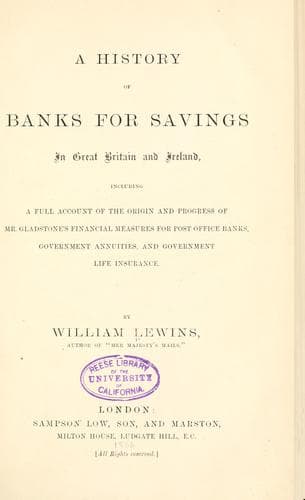
A History of Banks for Savings in Great Britain and IrelandLewins, William
History
A History of Banks for Savings in Great Britain and Ireland
Lewins, William
Postal savings banks -- Great Britain; Savings banks -- Great Britain
Thus, while it doubtless admits of question more than the other
details, no serious fault need be found with that clause which
provides the rate of interest to be given. Equalization in the rate of
interest of all Savings Banks connected with the Government is far
more necessary than that the standard of the one should be raised to
the standard of the other. The days have gone by when any dole of
charity should be held out to working men as an inducement to save: it
is more than questionable whether those days should ever have arrived.
The working classes do not want charity at the hands of the public;
they long wanted security and reasonable facilities: and when these
were provided, as they have been, they were willing that the rest
should be left to themselves. All interest given more than the money
actually produces or may fairly earn, is repugnant to them; or if it
is not, it ought to be _made_ repugnant to them.
The deficiencies, if we may so call them, of the Post Office Savings
Bank system, to which we promised to allude in closing this chapter,
are those features which have been inherited from the parent system,
and consist, of restrictions which, we think, are now as unnecessary
and undesirable as they are hampering and vexatious. By section 14 of
the Post Office Savings Bank bill it was ordered that "All the
provisions of the Acts now in force relating to Savings Banks as to
matters for which no other provision is made by this Act, shall be
deemed applicable to this Act so far as the same are not repugnant
thereto." Under this legislation all the restrictions which were
thought--especially during the earlier history of Savings Banks--to be
necessary to confine these institutions to the poorer classes, have
been continued down to the present time. The principal regulations to
which we refer are, the _Declaration_ which is required from any one
opening an account, and the _limitation of deposits_ to 30_l._ in any
one year, and 150_l._ in all; and that when deposit and interest
together reach 200_l._ all further interest shall cease. The reader
who may have followed us through our account will be aware of the
reasons which actuated the Legislature in making these arrangements.[194]
These reasons do not now obtain. No steps are taken (and we have never
heard that it is intended ever to take such steps) to confine the
benefits of the Post Office Banks to the labouring classes. Why,
therefore, these classes, or any other class allowed to deposit in
these banks, should be restricted to any amount--or, at any rate, such
a small one--it is difficult to understand. To the poor this
restriction forms a barrier to saving habits; with regard to any other
class, the amount might be as unlimited as it is in the Funds. As a
set-off against the unremunerative character, to say the least, of
small deposits, no limit should be placed on large ones. It is
obvious, that the larger the sums invested the greater will be the
Public-domain text, read in full here on John Shaqi.
Reviews
Reviews
No reviews yet
Be the first to share your thoughts on this work.
Elsewhere in the archive
Join the Discussion
Join the discussion
Sign in to leave a comment or review.
Sign InorCreate an account