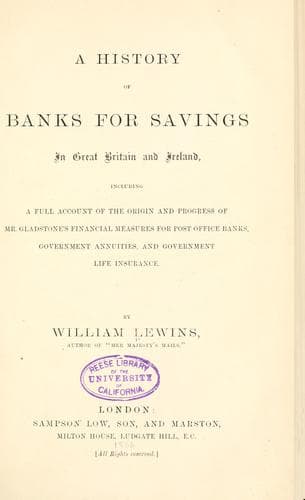
A History of Banks for Savings in Great Britain and IrelandLewins, William
History
A History of Banks for Savings in Great Britain and Ireland
Lewins, William
Postal savings banks -- Great Britain; Savings banks -- Great Britain
[179] Thus, as we learn from an authentic account, in Bristol the
old Savings Banks lost 700 and the Post Office Banks gained 2000
depositors; in Dublin the same relative proportions were 400 loss
and 1,400 gain; in the county of Kent there was a loss on the one
hand of 3,500, and a gain on the other of 9,300 depositors; in
Middlesex, the old banks lost 12,000, and the Post Office Banks
gained 42,000 depositors.
[180] _Report on the Post Office_, 1864.
[181] _Report on the Post Office_, 1864, p. 13.
[182] This Transfer was settled in November, 1863. The trustees
and managers at a special meeting deliberated whether or not to
carry on the Bank "under the increased responsibility imposed on
trustee by the 11th clause of the Consolidation Act (1863), or to
empower the managers to transfer the deposits to the Post Office
Savings Banks." They resolved by a majority of two to take the
latter step, and the transfer was made immediately afterwards.
[183] Since this Return was completed, the trustees of two other
banks have given notice to close. The one, a small bank at Castle
Wellan, in Ireland, and the other, the Leighton Buzzard Savings
Bank, make, with the Huntingdon Bank, a total of ninety-eight
transfers.
[184] The Huntingdon Savings Bank has given notice to close. The
capital of the Hunts Saving Bank amounts to £60,000.
[185] The fullest information on these matters may be gathered, in
cases where the reader is not thoroughly familiar with them, from
many sources. In addition to the Act, and the Regulations for the
Post Office Banks, three little manuals may be specially mentioned
to which reference may profitably be made. (1) _Handy Book on Post
Office Savings Banks._ London: Stevenson, 1861. (2) _Post Office
Savings Banks: a few Plain Words concerning them._ London:
Faithfull and Co. (3) _My Account with Her Majesty._ Reprinted
from _All Year Round_ and the _British Workman_.
[186] The well-known Form itself which in one piece of paper gives
the acknowledgment, and folded, leaves room for the address, was
designed and registered by Mr. Walshe, of the Post Office.
[187] Acknowledgments are received in most parts of England by
return of post, or within thirty-six hours; in some parts of
Cornwall and Wales two days, and in some parts of Ireland and
Scotland three days, are required.
[188] The departmental arrangements for these cases, technically
spoken of as "cross entries," need not be further explained.
[189] The depositor's book must, of course, be invariably
presented in every transaction, and when the depositor has
obtained repayment of all his balance the book must be given up in
order that the account may be closed.
Public-domain text, read in full here on John Shaqi.
Reviews
Reviews
No reviews yet
Be the first to share your thoughts on this work.
Elsewhere in the archive
Join the Discussion
Join the discussion
Sign in to leave a comment or review.
Sign InorCreate an account