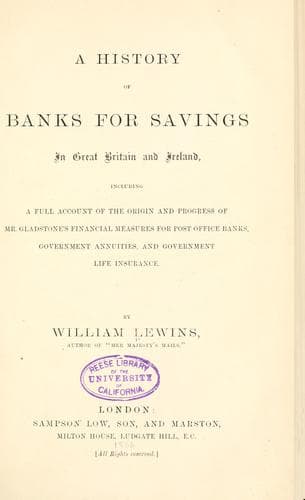
A History of Banks for Savings in Great Britain and IrelandLewins, William
History
A History of Banks for Savings in Great Britain and Ireland
Lewins, William
Postal savings banks -- Great Britain; Savings banks -- Great Britain
_Mr. Sheridan_, after replying vehemently to what he called a personal
attack on himself on the part of the Chancellor of the Exchequer when
dealing with unsound societies, disputed the need for the measure no
less than the principle upon which it was founded. As the spokesman of
Insurance Offices and Friendly Societies, Mr. Sheridan further
contended that the Post Office would never be able to manage all the
details of the business, and that, even if it did, the Government must
eventually be losers. "They might shut their eyes for a time," said
the member for Dudley, "but Government would ultimately have to come
to that House with shame, and with something like humiliation, to
confess that their experiment in commerce had failed, and that the
result had been to saddle the shareholders with a loss--those
shareholders being the already overburdened taxpayers of the country."
_Lord Stanley_ avowed his approval of the principles of the bill. He
thought it a great experiment, but an experiment which might very
possibly result in a reduction of pauperism. He urged the fullest
discussion; said it would do the bill no harm, but might on the
contrary tend to perfect its provisions. The speech of Mr. Gladstone
too, he thought, was a reason why the matter should not be hurried.
Mr. Gladstone had made statements which, however true they might
be--"and I am afraid that there is a good deal of truth in them--I
wish I did not think so,"--might require to be answered, and to give
an opportunity to answer them would only be fair play. After pointing
out one or two defects in the provisions, Lord Stanley promised his
valuable aid by saying, that he should be prepared to go into
Committee on the bill with a very sincere hope that it would pass, and
that they might find it, or make it, a workable scheme. _Mr. Hibbert_
and _Mr. Roebuck_ both warned the House against suffering a
"Constitutional Government" to be converted into what was termed a
"Paternal Government." In a characteristic speech, the latter
gentleman held that whatever concerned the individual was best left to
be done by the individual himself; that the Government was sure to
fail, as it had failed before, in interfering in matters of this kind;
and that the effect of such measures would be to make the people a set
of helpless imbeciles totally incapable of attending to their own
interests. _Mr. Newdegate_ and _Mr. W. E. Forster_ approved the
measure, but urged full consideration of it. _Mr. Bovill_ spoke very
strongly in favour. He believed, from the facts which had come within
his own knowledge and had been elicited in courts of law, that Mr.
Gladstone had rather understated than overstated the delinquencies of
Friendly Societies and Insurances Companies. One of the effects of the
Chancellor's speech, he thought, would be that a cloud of error and
prejudice which had been raised against the bill would be dispelled.
On the other hand, Sir Minto Farquhar, Mr. Ayrton, Mr. Urquhart, Mr.
Henley, Mr.
Public-domain text, read in full here on John Shaqi.
Reviews
Reviews
No reviews yet
Be the first to share your thoughts on this work.
Elsewhere in the archive
Join the Discussion
Join the discussion
Sign in to leave a comment or review.
Sign InorCreate an account