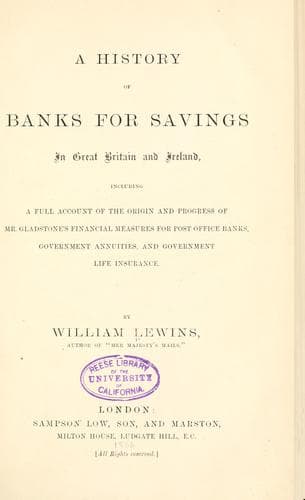
A History of Banks for Savings in Great Britain and IrelandLewins, William
History
A History of Banks for Savings in Great Britain and Ireland
Lewins, William
Postal savings banks -- Great Britain; Savings banks -- Great Britain
[203] Thus, at the age of thirty, a person with 8_l._ 14_s._ 9_d._
to spare may buy an assurance of 20_l._ to be paid at death. Two
or three years afterwards, and after a prosperous interval, he may
be disposed to increase that amount to 25_l._, 40_l._, or 50_l._
Suppose the latter sum, and he has attained the age of
thirty-three, he pays down another sum of 13_l._ 13_s._ 10_d._,
and then finds himself insured by these two single payments in the
sum of 50_l._ whenever death may occur. Of course he may stop
here; but he may also, if he thinks fit, go on adding, at such
intervals and in such amounts as may best suit his convenience, to
his original policy, till at last it acquires the value of 100_l._
[204] Many postmen and rural letter-carriers are insured in this
way for a sum of 100_l._
[205] It will be remembered that under the Act 16 and 17 Vict., c.
45, a person could only insure his life on condition that he
purchased an annuity. It is not so generally known that in the
course of eleven years not one proposal for this twofold contract
was ever received. It is not a little remarkable that now, this
arrangement being no longer compulsory, one in every hundred
proposers for Life Insurance also proposes for the purchase of an
Annuity.
CHAPTER XI.
CONCLUDING CHAPTER.
"And when I shall go to my account, and the great
Questioner whose judgments err not, shall say to me, 'What
didst thou with the lent talent?' I can truly answer,
'Lord, it is here; and with it all that I could add to
it--doing my best to make little much.'"--EBENEZER ELLIOTT.
The above words of the brave Corn Law Rhymer refer of course to far
higher duties than any with which we have dealt in this volume. That
application may be made of them even to our present subject is
nevertheless clear, and we leave the thoughtful reader to make it.
Real economy and frugality are virtues, and as such are inculcated in
the Christian code; neglect of them is condemned both by the moral and
the religious code. Christ expressed the very spirit of economy, care
of little things, a prudent thrift, and avoidance of all waste, when
after miraculously feeding the multitude in the desert He instructed
His disciples to "gather up the fragments that remain, that nothing be
lost:" and it is at least noteworthy, that this injunction immediately
followed another, wherein He warned the same men against the greed of
life, telling them that a man's riches did not consist in the
abundance of his possessions.
Public-domain text, read in full here on John Shaqi.
Reviews
Reviews
No reviews yet
Be the first to share your thoughts on this work.
Elsewhere in the archive
Join the Discussion
Join the discussion
Sign in to leave a comment or review.
Sign InorCreate an account