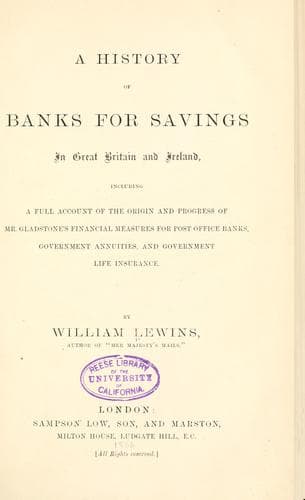
A History of Banks for Savings in Great Britain and IrelandLewins, William
History
A History of Banks for Savings in Great Britain and Ireland
Lewins, William
Postal savings banks -- Great Britain; Savings banks -- Great Britain
This may be perhaps a very fitting opportunity to say that a great
deal depends upon the motive and the object for which such virtues are
cultivated; that it is very possible to attach far too great an
importance to mere habits of saving: the motive for saving may at
times be vicious, and the purpose for which and the manner how the
hoards once scraped together may be applied, more vicious still. This
is so palpable that we need not dwell upon the subject. Not less so is
the wise medium course to be followed. The difference between those
who cultivate and those who neglect frugal and economical habits may
be expressed simply in the former having bread enough and to spare,
and the latter having bread for to-day--and not always that--but none
for to-morrow. It is by the capacity of looking forward in the present
moment to the possibilities of to-morrow that the civilized man is
distinguished from the savage; it is by the readiness with which
provision is made for possible emergencies that the wise man is
distinguished from the fool. Real economy, aided by prudence, is a
virtue. Cicero says that "the best source of wealth is economy;" but
it is also the best source of comfort, self-respect, and independence.
Prudence thinks of an adverse season amidst the prosperity of a good
one; and Economy arranges for the bad time. Prudence thinks of two
very possible and one certain contingency in the life of every human
being; and Economy weighs the chances well and provides for the
worst--it provides for the incidence of failing health, and for the
chances of losing, through one of the many eventualities of life,
worldly position, or the means of breadwinning; and it also does
something to provide for that time when the anxieties, the joys, and
the sorrows of life shall be hushed in death.
It is well, therefore, and it is almost indispensable, that these
habits should be cultivated; it is well also, and quite indispensable,
that means and provisions should be used to this end. The first stone
which the learned Wotton refers to in the motto on the first page of
this volume, is without doubt the first act in the habit of economy;
and we have been endeavouring throughout the course of this history to
point out with some approach to accuracy the exact spot where a person
may lay this indispensable "first stone," where he may probably best
lay the second or third, and how possibly he may commence with the
superstructure.
Public-domain text, read in full here on John Shaqi.
Reviews
Reviews
No reviews yet
Be the first to share your thoughts on this work.
Elsewhere in the archive
Join the Discussion
Join the discussion
Sign in to leave a comment or review.
Sign InorCreate an account