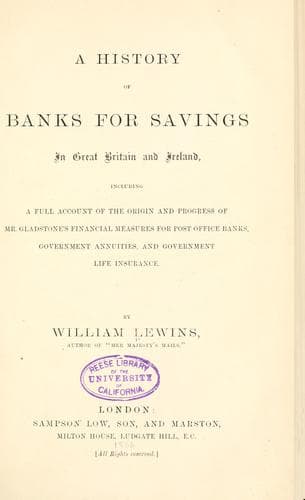
A History of Banks for Savings in Great Britain and IrelandLewins, William
History
A History of Banks for Savings in Great Britain and Ireland
Lewins, William
Postal savings banks -- Great Britain; Savings banks -- Great Britain
Without reference, however, to the Government schemes just referred
to, the State sets an admirable example to all large employers in the
provident arrangements which have been made for public officers; and
we think there must be much in the provisions in question which might
be turned to good account in, and be made applicable to, large private
concerns. Few Government _employés_ should ever come to beggary; if
they have not been prematurely cast aside, either by wilful misconduct
or gross carelessness on their own part, they cannot come to the
parish: further, great numbers of them are assisted to make provision
for their families at their death. Nearly all Government servants may
be said to have bargained with their masters at the time they entered
the service, not only for a fair day's wage for a fair day's work, but
for nearly all the provisions of a Friendly Society during sickness;
for a Deferred Annuity when they are past work, or after a certain
age; and in some instances--it ought to be in all--for assistance
towards insuring their lives for the benefit of their family. It were
idle to say that none of these considerations enter into the original
contract, and have had no influence on the scale of remuneration paid
for actual work; it were far more to the point to say that departments
of Government compel their servants to be provident and to prepare;
for sickness, old age, and death, and make it involuntary in the case
of sickness and old age, by taking the necessary payments upon
themselves.
Of the scheme of Life Insurance at present in force in the Post
Office, for example, we spoke in the previous chapter. With regard to
sickness, a certain time is allowed for full pay; another definite
period for half-pay. In respect to Superannuation Allowances, which we
have termed the Deferred Annuities, it is true that at one time civil
servants were required to pay towards it out of their salaries; but
this has been discontinued by Act of Parliament, and the present
arrangement may simply be considered as a small rise in the rate of
wages--the deduction being compulsory on all classes alike.
Why should not a similar plan, or at any rate the principle of it, be
urged upon private employers? Spite of some of the difficulties which
would at once present themselves, we believe that there is little
impracticable about it, and little that might not be surmounted. Even
if it should be found impossible to apply such arrangements to many
concerns, there is still the admirable machinery designed in connexion
with the Annuities Act of 1864; and we again commend the plan to the
attention and candour of large employers.
Public-domain text, read in full here on John Shaqi.
Reviews
Reviews
No reviews yet
Be the first to share your thoughts on this work.
Elsewhere in the archive
Join the Discussion
Join the discussion
Sign in to leave a comment or review.
Sign InorCreate an account