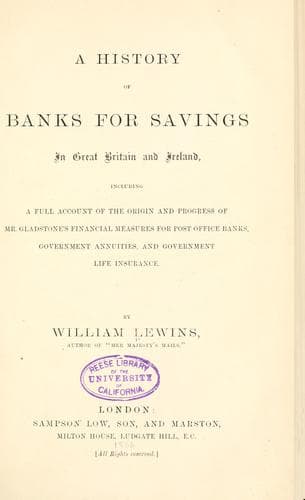
A History of Banks for Savings in Great Britain and IrelandLewins, William
History
A History of Banks for Savings in Great Britain and Ireland
Lewins, William
Postal savings banks -- Great Britain; Savings banks -- Great Britain
The instances which had
come before him of persons who before the establishment of Savings
Banks had never saved a penny, but who then had made ample provision
for a rainy day, were cheering in the extreme. He proceeded to give
particulars of several instances of the kind, mentioning them, as he
put it, "to induce hon. gentlemen to exert themselves, and that they
might not sit with their hands before them, believing that nothing
could be done." The moral good to be expected from these banks was
great and obvious. He hoped and expected that they would gradually
tend to revive in the lower classes that decent spirit of
independence, now almost extinct, which shrinks from accepting
parochial relief; the poor man would learn to regard his own industry
and labour as the source whence he was to derive temporary aid in the
hour of sickness, or permanent support when the approaches of age
should unfit him for active exertions. Not that this matter was
applicable only to the poor; a consideration of the subject in all its
bearings might well be given to it by the rich on their own account;
he thoroughly believed that the poor-rates of the country would
diminish in proportion to the spread of Savings Banks among the
masses. _Mr. Thompson_, a Yorkshire member, expressed his warmest
approbation of the proposed bill. In Yorkshire, he knew there was a
great desire to establish Savings Banks of this sort, but the better
classes were afraid of doing so, on account of their apparent
complexity, and because they had not received up to this time the
sanction or countenance of the Legislature. He hoped the provisions of
the proposed bill would be as simple as possible, and afterwards that
the bill and its clauses would be made as public as possible. Hundreds
of working men, to his knowledge, might easily save ten shillings a
week, whereas they did not then save a penny; nor could they be blamed
to any great extent so long as they were without the requisite
machinery for acting differently. Establish these banks, and place
their working under proper Acts of Parliament, and he should then say
that many who were accustomed in times of scarcity to solicit
parochial relief would have no excuse for their conduct; if they did
not avail themselves of the opportunity of becoming independent he
would rather punish than assist them. Thus early were our legislators
alive to the maxim that "the only true secret of assisting the poor is
to make them agents in bettering their own condition." The _Chancellor
of the Exchequer_ (Mr. Vansittart) believed that nothing tended more
to the independence of the poor than their learning to support
themselves by their own exertions. He thought the object of the
proposed bill would be congenial to the feelings of the whole House.
On the part of the Government, he was ready to offer his best
assistance on behalf of an institution such as the Savings Bank, where
rich and poor might meet together and mutually combine in promoting,
Public-domain text, read in full here on John Shaqi.
Reviews
Reviews
No reviews yet
Be the first to share your thoughts on this work.
Join the Discussion
Join the discussion
Sign in to leave a comment or review.
Sign InorCreate an account