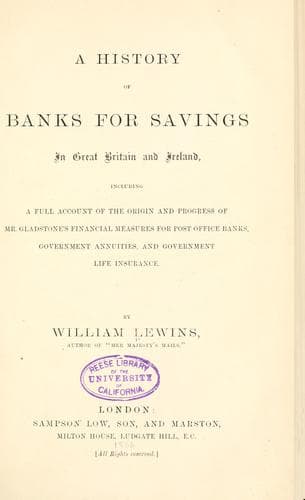
A History of Banks for Savings in Great Britain and Ireland — John Shaqi
A History of Banks for Savings in Great Britain and IrelandLewins, William
History
A History of Banks for Savings in Great Britain and Ireland
Lewins, William
Postal savings banks -- Great Britain; Savings banks -- Great Britain
within the reach of their own exertions and industrious application,
would be effectual. After a little further opposition, during which
another member said that the bill would do more harm than good--that
Savings Banks were going on extremely well without any Act of
Parliament, _Mr. Wilberforce_, ready at all times to forward any
measure which seemed likely to benefit the poorer and more defenceless
portions of society, congratulated his friend on his proposals, and
said that the system of Savings Banks pleased him most because it was
so eminently adapted to teach the poor how much they might do for
themselves by their own self-denying exertions. This was one of the
class of things for which he, the House, and the country ought to be
extremely indebted to all who had been instrumental in originating it
and bringing it to greater perfection. "Whatever difference of
opinion," continued Mr. Wilberforce, "there might exist as to the Poor
Laws, it was of all things desirable to countenance and foster so
sanative a principle as that on which Savings Banks were founded." The
second and principal reading of the bill took place on the 15th of
May, 1817, on which night many petitions were presented in its favour,
and only three--viz., from Norwich, Hertford, and St. Paul's, Covent
Garden--against it. All opposition, however, to the bill resolved
itself into simply contesting one or two of its clauses. An attempt
was made to throw out the clause which obliged the Trustees of Savings
Banks to vest all moneys received by them in the Public Funds, several
members contending that at any rate some of the money might be much
better employed on mortgage, to the relief of many different interests
in the immediate neighbourhood, and to the greater productiveness of
the money so lent. The arguments used on this occasion were very
similar to those occasionally used now in relation to the same
subject, and they were then as unavailing as they have been
subsequently: the preponderating opinion was that the _safety_ of the
investments was, and ought to be, the first and greatest
consideration. The clause, however, which proposed the giving of
premiums out of the parish funds to those contributors who had done
best in the way of saving money, fared worse, being rejected in
committee almost unanimously. The growth of such principles could not
be forced, and, if they grew at all, they would do better without the
crutches eleemosynary aid. At the third reading, a spirited contest
arose about the proviso that depositors in Savings Banks should not be
disqualified from receiving parochial relief. _Mr. Rose_ contended
that anything, which would have a tendency to make the poor think that
the richer classes were legislating with ulterior objects in view,
such as to get rid of poor-rates, would throw obstacles in the way of
Savings Banks. There would be no need to think of such considerations
in a few years, when Savings Banks were more firmly fixed amongst the
Public-domain text, read in full here on John Shaqi.
Reviews
Reviews
No reviews yet
Be the first to share your thoughts on this work.
Join the Discussion
Join the discussion
Sign in to leave a comment or review.
Sign InorCreate an account