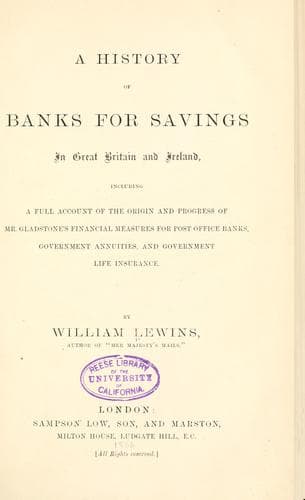
A History of Banks for Savings in Great Britain and IrelandLewins, William
History
A History of Banks for Savings in Great Britain and Ireland
Lewins, William
Postal savings banks -- Great Britain; Savings banks -- Great Britain
A month afterwards, the Returns having been furnished, Mr. Hume
returned to the charge. The accounts had more than borne him out in
all particulars. He now again asked if the daily loss ought to be
suffered in the financial state the country was in. The Act regulating
Savings Banks ought to be repealed, and another passed in its place.
His opinion was, decidedly, that Government should just give the
interest which it realized by the Savings Bank money, and not add a
farthing to it. "At a change in the price of Stock," added the
reformer, "Government might very possibly lose three or four millions,
and yet the depositors would not suffer the loss of a penny." Much as
he wished for the progress and advancement of the poorer classes--and
few, we think, worked harder to obtain it for them,--he contended that
these classes ought to be placed precisely in the same situation as
other people who had capital to invest. Another point which Mr. Hume
dwelt upon was the _surplus money_ which managers of Savings Banks had
in their possession untouched, after paying their depositors all the
interest that was allowed them. At that time Mr. Hume stated that the
surplus in the Newcastle Savings Bank, after paying the expenses of
management, amounted to 4,810_l._ and in the Exeter and Devon Bank to
a still larger sum; and this money which had been paid by Government
and saved after the Trustees had given a liberal interest to
depositors, was now turned into an invincible argument for some change
in the law. Mr. Hume concluded with expressing a hope that Government
would bring in a bill to amend the law relating to Savings Banks, or
at any rate not throw any obstacles in the way of some private member
doing it. The Secretary of the Treasury said, in reply, that Mr. Hume
had stated the case fairly and correctly; and that the Chancellor of
the Exchequer fully intended during the present session to bring in a
bill with which he hoped _to satisfy all classes_.[37] The
vicissitudes of party prevented this high Government functionary from
carrying out his laudable, but very impossible design. In a few weeks
the Chancellor is on the other side of the House, and another occupies
his place. A bill, however, was introduced on the 5th of June, 1828,
by Mr. Pallmer, which, supported by the new Administration, was passed
through Parliament, and became law in the same year.[38] In
introducing this bill, _Mr. Pallmer_ said it was quite obvious that
the laws which affected Savings Banks ought to be as clear and as
distinct as possible. Savings Banks were now very important
institutions, and the welfare of thousands was connected with them. At
that time there were no less than five Acts of Parliament regulating
Savings Banks, and these Acts, which contained 150 clauses, involved
an enormous amount of confusion and perplexity. He would in the place
of these five Acts, propose an Act, simple and consolidated, of thirty
or forty clauses.
Public-domain text, read in full here on John Shaqi.
Reviews
Reviews
No reviews yet
Be the first to share your thoughts on this work.
Join the Discussion
Join the discussion
Sign in to leave a comment or review.
Sign InorCreate an account