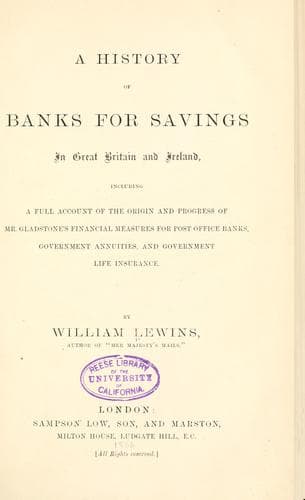
A History of Banks for Savings in Great Britain and IrelandLewins, William
History
A History of Banks for Savings in Great Britain and Ireland
Lewins, William
Postal savings banks -- Great Britain; Savings banks -- Great Britain
Remembering that this table does not give the actual business done by
Savings Banks within this period,--which, indeed, from the absence of
proper returns in the earlier years of those Banks it would be
difficult to present,--many instructive lessons may be gathered from
it as to their value and utility. In fact, however, and for all
practical purposes, the amounts remitted by the Trustees to the
National Debt Office very fully represents the progress of Savings
Banks, for they may be considered as representing so much surplus
every year, after all the claims on the banks had been met. The
variations observable in the returns are accounted for quite easily by
the state of the country at the time. When the amount falls, it may be
taken for granted that the country is passing through a period of
exceptional suffering and trial, and that the funds which have been
patiently accumulated for times of need are thus made available when
the necessity arises for it. The country was unusually prosperous, for
example, in 1823-4, and an enormous surplus was returned. In 1825, as
if to mark the coming storm, there is a heavy fall in deposits. In
1826, the tables were turned, not only in a figurative, but, so far as
we are concerned, in a literal sense. The circumstance can be only too
well explained. The _Quarterly Review_ of that time gives a glowing
account of the increased wealth of all classes, especially those of
the trading community.[50] "The increased wealth of the middle classes
is so obvious, that we can neither walk the fields, visit the shops,
nor examine the workshops and storehouses, without being deeply
impressed with the changes which a few years have produced. In the
agricultural districts we do not, indeed, see such great strides, but
we see universal advancement." Then we have the familiar record of the
exportation of gold; of the Bank of England and provincial banks
deluging the country with notes.[51] Money became so abundant that a
terrible rage for speculation set in; joint-stock companies with
unlimited liability were projected for every imaginable object. On the
reorganization of the South American republics, which had just then
been effected, all sorts of proposals for mines were started; the El
Dorado had to be found now, if ever.[52] In the session of 1825, 438
petitions for private bills were presented, and 286 private acts were
passed. The King, even, was so deceived by the general appearance of
things, or was so purposely blind to their real state, as to
congratulate the country, in July, 1825, on "the prosperity everywhere
pervading the country." The time arrives when anxious speculators
begin to look out for some return for their money; they are told that
their capital cannot possibly realize so soon; then the bankers are
besieged, but, tempted by the abundance of money, they had discounted
bills at long dates to an enormous extent, and lent money upon
securities which were presently seen to be almost worthless. Then came
Public-domain text, read in full here on John Shaqi.
Reviews
Reviews
No reviews yet
Be the first to share your thoughts on this work.
Elsewhere in the archive
Join the Discussion
Join the discussion
Sign in to leave a comment or review.
Sign InorCreate an account