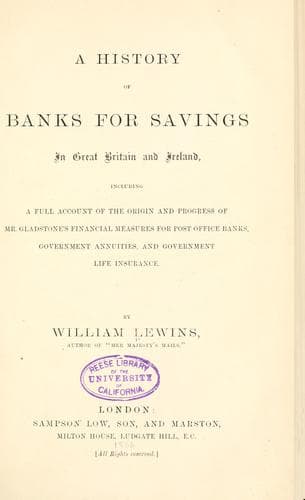
A History of Banks for Savings in Great Britain and IrelandLewins, William
History
A History of Banks for Savings in Great Britain and Ireland
Lewins, William
Postal savings banks -- Great Britain; Savings banks -- Great Britain
the panic,--and then the crash. Commercial houses first failed, big,
substantial firms, which were supposed to have the wealth of Croesus
at their back, came down thunderingly. "Many a firm of unimpeachable
honour and unquestionable solvency was compelled to bend before the
storm." Then came the turn of the great banks: they had advanced their
money to the merchants, and now that the security had failed, they
also must bend before the blast. On the 5th of December, the news
spread with the wings of the wind, that the banking house of Sir Peter
Cole and Co. had failed; next day, Williams and Co. stopped payment;
and from that time, without intermission, seventy country banks went
down within six weeks.[53] How things were restored to their original
condition, and how promptly the Government acted during the terrible
panic, we need not stay to tell. Savings Bank deposits fell from about
three millions in 1825, to less than half that sum in 1826. More money
was withdrawn in the year of the panic than had been withdrawn
altogether since the year 1820. It is not a little curious, as showing
that depositors in Savings Banks are less inclined to speculation than
other classes, to point out, that during the panic a sum equal to at
least fourteen millions sterling must have been safely lodged in the
different provident banks of the country; and that little money was
hazarded in the speculations of the time is evident from the fact that
only one-tenth part of the whole amount of deposits was withdrawn to
supply emergencies. In this way were those people rewarded who
preferred a safe deposit with a reasonable interest to "cent. per
cent." and unlimited risk.
Nor can we stop to describe the result of the panic on the industrial
classes. The picture of that terrible time has often been drawn, when
thousands of hungry, infuriated men, roused by the sorest distresses,
went about robbing shops, breaking machinery, rick-burning, chased by
the constabulary, and fired upon by the soldiery. The time was a most
disastrous one, but it was full of lessons for all classes. Many of
the provident poor suffered little, and never had anything to fear, on
account of having prepared themselves for such calamities. Those of
the poor who acted less wisely, and ventured their little surplus in
some speculation or other, met with few condolences. When a portion of
them petitioned the House of Commons for relief, they were rather
roughly told that they ought to have deposited their earnings in
Savings Banks. It was on this occasion that Sir Robert Peel replied to
this taunting, and recognised the imperfections of the existing
machinery, by asking, indignantly, how the House could expect this to
be done in cases where "the Savings Bank was perhaps twenty miles from
the working man's home."
Public-domain text, read in full here on John Shaqi.
Reviews
Reviews
No reviews yet
Be the first to share your thoughts on this work.
Elsewhere in the archive
Join the Discussion
Join the discussion
Sign in to leave a comment or review.
Sign InorCreate an account