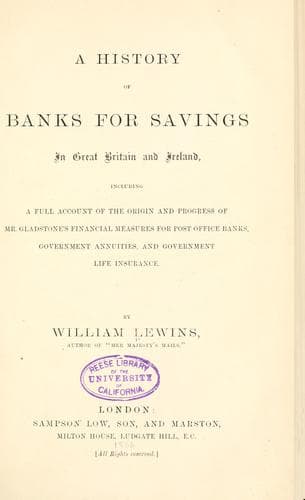
A History of Banks for Savings in Great Britain and IrelandLewins, William
History
A History of Banks for Savings in Great Britain and Ireland
Lewins, William
Postal savings banks -- Great Britain; Savings banks -- Great Britain
To return again to the table. In 1827 and 1828 the accounts show a
much more healthy state of things, and it is clear that the deposits
are steadily gaining their natural ascendancy over the withdrawals,
when there is another rebound, of a greater magnitude than ever; the
withdrawals not only exceeded the deposits of 1829, but the deposits
of 1830 added thereto. There can be no question that, primarily, the
Savings Bank Act of 1828, which came into operation on the November of
that year, and under which the amount of interest allowed on deposits
was reduced by 14_s._ per cent., was the cause of this exceptional and
most important change. Like all misfortunes of this nature, it had its
bright side, and was far from being an unmixed evil. As we have
already endeavoured to show, a large number of depositors up to this
period belonged to classes much above the artisan class; and as the
former looked more to the interest given, while the industrious
classes thought most of the security offered, it is no wonder and no
calamity that the connexion which the higher classes had formed with
Savings Banks was now dissolved. Henceforth, the returns may be looked
upon as more than ever the result of habits of economy and thrift, and
as representing the surplus money of the artisan and the lower
portions of the middle classes.
The year 1830 shows that confidence was slowly returning, when again
there is a period of great depression. Two millions of capital is
withdrawn in 1831-2, over and above the deposits of those years, to
meet demands on the banks. The political agitation of those years
sufficiently accounts for this state of things. It will require little
to be said in order to show that a time like that was likely to tell
largely against such institutions as those under consideration. The
time was one of great anxiety among all classes, and amidst the
uncertainties and anticipations which followed in rapid succession, it
would be only bold people, and those of more than average intelligence
and power of mind, that could confide, without the smallest degree of
wavering, in the stability of the country. We had a turbulent
population at home, and amidst much agitation for their undoubted
political rights, there were many clamouring for bread, many
clamouring for work, and thousands for they knew not what: and France
offered an illustration of what might possibly happen. With such
manifest agitation everywhere, with funds falling, and the entire
political sky lowering, there cannot be much wonder that many waited
patiently for some issue before they trusted to resources other than
their own. Not only were actual hardships endured during this great
crisis in our history, but the working classes brought hardships upon
themselves. Led by intemperate and impracticable men, many thousands
of the more ignorant beguiled themselves into believing that the
Reform Bill would do everything for them, and they would need to do
Public-domain text, read in full here on John Shaqi.
Reviews
Reviews
No reviews yet
Be the first to share your thoughts on this work.
Elsewhere in the archive
Join the Discussion
Join the discussion
Sign in to leave a comment or review.
Sign InorCreate an account