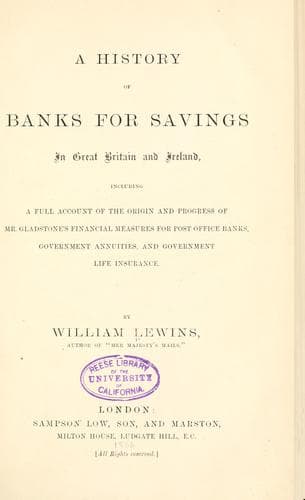
A History of Banks for Savings in Great Britain and IrelandLewins, William
History
A History of Banks for Savings in Great Britain and Ireland
Lewins, William
Postal savings banks -- Great Britain; Savings banks -- Great Britain
|Somerset | 436,002| 22,019 | 679,072| 105,153| 176,286 | 157,022 |
|Southampton | 354,940| 23,942 | 687,473| 99,324| 203,466 | 142,507 |
|Stafford | 510,206| 15,368 | 452,306| 84,399| 120,512 | 95,242 |
|Suffolk | 315,129| 11,972 | 348,176| 89,939| 245,509 | 138,228 |
|Surrey | 582,613| 31,250 | 749,199| 159,068| 261,501 | 199,477 |
|Sussex | 299,770| 15,709 | 420,570| 84,190| 246,626 | 145,013 |
|Warwick | 402,121| 22,291 | 468,270| 93,168| 158,159 | 102,828 |
|Westmoreland | 56,469| 942 | 24,719| 1,920| 22,283 | 17,607 |
|Wilts | 260,007| 11,706 | 413,941| 97,140| 173,925 | 133,573 |
|Worcester | 223,484| 12,218 | 401,330| 53,978| 81,612 | 62,958 |
|Yorkshire | 1,591,584| 69,545 |2,105,866| 435,129| 418,742 | 372,166 |
+--------------+----------+----------+---------+--------+---------+---------+
In every county, as may be seen from this table, there is a decided
increase in the number and amount of Savings Banks deposits between
the two periods; and in every instance, except two, there is a decided
decrease in the amount spent on the relief of the poor. Not only so,
but taking the two exceptional cases, we find that in the one case, a
small county, there had not up to this time been any Savings Bank
established; and in the other instance, that of the large and populous
county of Lancaster,--which shows an increase instead of a diminution
on the two years in the amount of poor relief,--it is not less curious
that its industrial population have never patronised the Savings Banks
to the same extent, in proportion to their number and earnings, as the
same classes have done in the country generally. Further, the three
counties of Kent, Middlesex, and Norfolk, which in 1841 had the
greatest number of depositors in Savings Banks in proportion to their
population, also exhibit the pleasing fact of the greatest diminution
in the amount spent in the relief of the poor. It may be said that
many considerations ought to enter into such calculations as those we
are making, and that at best such statistics only prove that the same
causes, such as abundance of work, good harvests, &c., will contribute
to the increase of surplus funds, and the decrease in measures of
relief. But it must be borne in mind that prosperous trade does not
necessarily produce frugal people and provident habits, though it
often enough leads to unnecessary and vicious expenditure. By far the
greater part of the decrease in the sums given for relief is
unquestionably owing to the operations of the Poor Law Amendment Bill
already referred to, which Lord Althorp carried through Parliament.
Truly stigmatized before his time as "the great political gangrene of
England," the old Poor Laws of this country first made paupers, and
then promptly maintained them. It is, however, the relative proportion
Public-domain text, read in full here on John Shaqi.
Reviews
Reviews
No reviews yet
Be the first to share your thoughts on this work.
Elsewhere in the archive
Join the Discussion
Join the discussion
Sign in to leave a comment or review.
Sign InorCreate an account