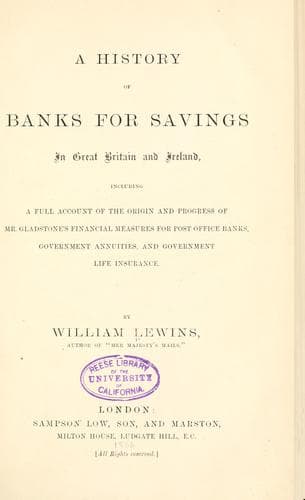
A History of Banks for Savings in Great Britain and IrelandLewins, William
History
A History of Banks for Savings in Great Britain and Ireland
Lewins, William
Postal savings banks -- Great Britain; Savings banks -- Great Britain
in which the increase of Savings Bank deposits stood to the decrease
of the sums for relief that we wish here to impress upon the reader,
leaving him to form his own conclusions. And with all respect to those
who framed the measure of 1834, which was very beneficial to the
country and only just to the independent poor, we think the results
have been rather too much magnified. From the year 1820 we can plainly
trace a manifest improvement in the condition of the poor, and we have
not scrupled to ask for a place for the Saving Bank system among those
important agencies which have led to this improvement. Still, taking
the measures of Poor Law relief as a good criterion of their
condition, we find that the sum total paid for the ten years between
1811 and 1821 was 68,000,000_l._, giving a yearly average of
6,800,000_l._ In the ten years ending 1832, the amount of poor rates
was 62,900,000_l_., or a yearly average of about 6,200,000_l._ Thus we
have, in spite of what was considered the iniquitous system of relief,
and in spite of an increase of population amounting to 16 per cent., a
clear reduction of 5,000,000_l_. within ten years. The advancement is
still more clear, if we take the case of the large centres of
population, but this is perhaps, unnecessary.
The Returns, however, of the Registrar General may be supplemented by
Revenue Returns for the same period, from which the improvement in the
condition of the industrial classes may be made still more palpable.
In 1814 the consumption of tobacco was 15,000,000 lbs.; in 1832 it had
increased to 20,000,000 lbs., an augmentation of 31 per cent., while
the population only showed an increase of 24 per cent. during the same
interval. The amount expended upon articles which, like tobacco and
intoxicating drinks, are not, to say the least, of the first
necessity, forms no incorrect measure of the progress of the nation,
and of the ability of the people to bear the national burdens which
must be imposed. In 1814 the consumption of sugar was 1,997,000 lbs.;
in 1832 it amounted to 3,655,000 lbs., an increase of 83 per cent. to
be set against the above rate of increase in the population. The tea
consumed in 1814 was 19,224,000 lbs.; in 1832 it had increased to
31,568,000 lbs., or an increase of 65 per cent.; and coffee increased
from 6,324,000 in 1814 to 22,952,000 lbs., or an increase of 183 per
cent., in 1832. The increased consumption of such articles, (not
forgetting reductions in price,) was an evidence of nothing, if not of
the growing prosperity of the people. Such items show that the people,
as a mass, enjoyed a greater command over the comforts of life than
formerly. The rich man, of course, added little or nothing to his
ordinary consumption of the articles that were necessary to his
comfort or convenience, but with the poor it was very different. For
example, the amount of silk imported during the period of which we
have spoken varied but little, while the imports on the article of
Public-domain text, read in full here on John Shaqi.
Reviews
Reviews
No reviews yet
Be the first to share your thoughts on this work.
Elsewhere in the archive
Join the Discussion
Join the discussion
Sign in to leave a comment or review.
Sign InorCreate an account