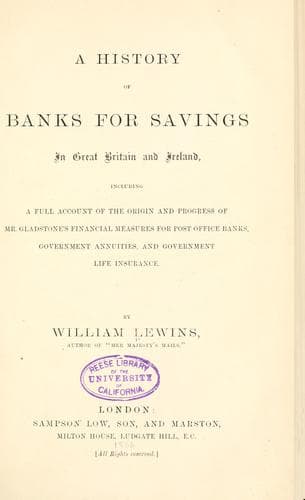
A History of Banks for Savings in Great Britain and IrelandLewins, William
History
A History of Banks for Savings in Great Britain and Ireland
Lewins, William
Postal savings banks -- Great Britain; Savings banks -- Great Britain
"A labourer sixty years of age has, by hook or crook,
saved 500_l._ We know such a case. The 500_l._ is the
plague of his life. It would be a mercy to swindle him out
of it, except that he would probably feel a good deal at
the loss. Could he forget it, he would be both a happier
and better man. To begin with, it is a guilty possession.
His father is maintained by a distant Union; his sons and
daughters are all but forbidden his cottage. He invests it
in secret.... When he dies his children will squander it,
not in dissipation, but in the mere feebleness and
incontinence of ingrained poverty."
Another extract striking at the root of all habits of providence and
thrift:--
"When a labourer has saved 50_l._ or 100_l._ then the
greatest difficulty comes: what is he to do with his
money? He has caught a tartar. His usual course is a very
natural one, because it is the first course that
offers--to open a public house. He does so, and generally
and happily loses his money. A labourer with 200_l._ in
his pocket has a very fair prospect of the union workhouse
before him. He is not commercial enough to open a shop,
and small farms are obsolete. He may, to be sure, shut his
doors against all his kith and kin, _and buy a selfish
annuity with the sum_, which will just keep him while he
rots and dies. But will he, and who is to advise him to do
so?"
Granted that things are very different now to what they were when
these remarks were penned, and that investments of any sort may now be
made with comparative ease, it seems to us that the argument of the
_Times_ was based throughout on false assumptions; that it is a
mistake to suppose that the primary or sole object of Savings Banks
was to build up capitals for investiture in business or trade, and not
for expenditure on the necessaries or comforts of life; nor to make
every labourer a capitalist, in the usual acceptation of that term,
but to enable him to end his days in some sort of independence, and in
some degree of peace and comfort. Savings Banks at their establishment
were, always have been, and still are, meant for accumulations, not to
be traded with,--though, of course, there is no prohibition,--but
always have had and still have a homelier aim. They are meant to
inculcate the habit of laying by for an evil day, for old age, the
winter of life, or as Dr. Chalmers, we believe, strikingly puts it,
"for those mishaps and sicknesses which might be termed its days of
foul weather." In such case the money will not be traded with, but in
right season spent. The answers to some of the arguments of the
_Times_ are indeed so obvious that it seems superfluous even to state
them. Money in hand is all the world over better than beggary. That
the inculcation of such a principle will tend to fill our towns with
paupers is monstrous absurdity. The object and design of Savings Banks
Public-domain text, read in full here on John Shaqi.
Reviews
Reviews
No reviews yet
Be the first to share your thoughts on this work.
Elsewhere in the archive
Join the Discussion
Join the discussion
Sign in to leave a comment or review.
Sign InorCreate an account