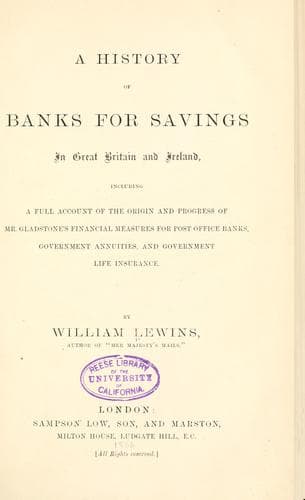
A History of Banks for Savings in Great Britain and IrelandLewins, William
History
A History of Banks for Savings in Great Britain and Ireland
Lewins, William
Postal savings banks -- Great Britain; Savings banks -- Great Britain
cotton wool, the staple fibre of the masses, increased from
152,000,000 lbs. in 1820 to 259,000,000 lbs. in 1832, or an increase
of 70 per cent.[58]
Enough has been said, we hope, to show the gradual progress made in
these years in all that relates to the social advancement and
well-being of the people, and to what extent Savings Banks played a
part on that advancement. Because these institutions have been proved
to create frugal habits--in much the same way that the supply of
intoxicating drinks creates in many cases a demand for them--as well
as to give them direction and encouragement, we have endeavoured to
prove their right to a foremost place among the many other mighty
engines of civilization which have made Great Britain what it is. And
now we must conclude this chapter with a less pleasant task, and refer
briefly, at present, to two foes to Savings Banks, one without and one
within, both of which had a very powerful effect as hindrances on the
progress of these useful institutions. We refer to the doubts which
began to be cast on the utility of Savings Banks by portions of the
public press, and the serious frauds which now for the first time
began to engage public attention. In 1844, when Mr. Goulburn's bill
was under discussion and subsequently to that, several newspapers
began to dispute that Savings Banks were either so useful or so wise
as had been generally thought up to that period. The _Times_
newspaper, with an hostility which Dr. Chalmers characterized as "most
glaring" and "likely to mislead every artisan from the path of his
true interests," laughed at and ridiculed the system long after it had
proved its usefulness in numerous ways. That paper, which opposed the
new Poor Law of 1834 with great bitterness, and had treated with
manifest injustice other schemes for the social amelioration of the
poor, devoted several editorial articles in 1844 to throw discredit on
the institution of Savings Banks. The articles in question were
calculated to work a mischievous practical influence on many readers,
especially on those who gave little attention to the subject of
political economy; they were meant to create a spirit of opposition to
Savings Banks, but in many cases they must have had the opposite
effect and failed to convince all who were not equally perverse. To
show the kind of argument indulged in by the leading journal at a time
when it was equally as now the greatest newspaper power in the land,
when its rebuke or praise had a weighty effect on any important
measure, and when Cabinet Councils debated whether it should be
propitiated or defied,[59] we need only give the following extracts:--
Public-domain text, read in full here on John Shaqi.
Reviews
Reviews
No reviews yet
Be the first to share your thoughts on this work.
Elsewhere in the archive
Join the Discussion
Join the discussion
Sign in to leave a comment or review.
Sign InorCreate an account