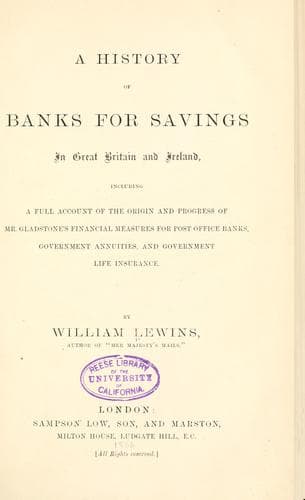
A History of Banks for Savings in Great Britain and IrelandLewins, William
History
A History of Banks for Savings in Great Britain and Ireland
Lewins, William
Postal savings banks -- Great Britain; Savings banks -- Great Britain
can refrain from doing harm, since they cannot do good; and will not
press this most discreditable bill through the House at the end of
August without necessity for it, and against the opinions of those
best calculated to form a judgment." Irish members, seeing the turn
the discussion was taking, urged that, at any rate, the bill might
apply to Ireland. It was patent to everybody that the poor depositors
in Ireland needed every protection, however secure the same classes
might feel in England. In Ireland such a bill was really required, and
was necessary, to restore confidence in Savings Banks;[80] why not
make it apply to Ireland only? After an unsuccessful attempt on the
part of Lord George Bentinck to throw out the bill altogether, it was
decided, on the motion of Mr. Wodehouse, and by a vote of thirty to
eleven, that the words "Great Britain" should be struck out of the
motion, and that the Act should simply apply to Irish Savings Banks.
That the bill now passed was a beneficial change in the law, and a
considerable step in the right direction, no one now doubts; had not
the perverseness of Savings Bank officials prevented the Government
from making its provisions apply to England, much subsequent suffering
and grievous loss would have been saved to many of the best classes of
our industrial population. It was a safeguard such as was wanted in
Ireland, and it answered admirably.
The bill having been made law, and new depositors secured to a
considerable extent from robbery and exaction, the attention of the
Legislature was called to those who had lost their all by past frauds;
and the records of Parliament show that one member after another
reverted to such topics until redress was obtained. On the 29th of
March, 1849, _Mr. Reynolds_, the member for Dublin, moved for the
appointment of a Committee to investigate into the case of the Cuffe
Street bank in Dublin, and to ascertain who were liable for the
extensive frauds in that bank. He alluded to the unsatisfactory result
of the previous inquiry, which was, indeed, not meant to be final. In
making his motion, Mr. Reynolds, who had access, of course, to the
best sources of information, entered into a full account of this bank,
stating, indeed, many of the facts which we have already given. He
complained most bitterly of the Government, who had accepted the
advice of a "flippant barrister," as Mr. Pratt was designated, and who
had suffered the bank to go on when it was known to be in a state of
hopeless insolvency. He described the heartrending scenes which he had
witnessed in Dublin, owing to the failure of the bank, and during the
last eighteen months, and related some of the cases to the House,
where they had ended in insanity, death, or suicide. That the
depositors were mostly poor persons he proved, by stating the average
amount due to each of the 1,664 persons who were creditors of the bank
to be but 27_l._ Mr. Reynolds added, that he had no hesitation in
Public-domain text, read in full here on John Shaqi.
Reviews
Reviews
No reviews yet
Be the first to share your thoughts on this work.
Elsewhere in the archive
Join the Discussion
Join the discussion
Sign in to leave a comment or review.
Sign InorCreate an account