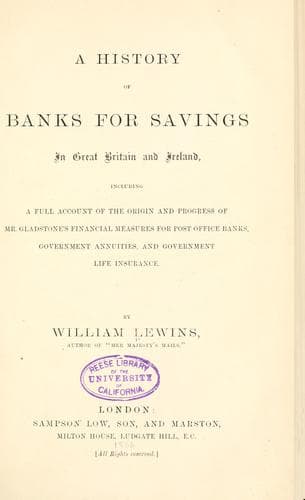
A History of Banks for Savings in Great Britain and IrelandLewins, William
History
A History of Banks for Savings in Great Britain and Ireland
Lewins, William
Postal savings banks -- Great Britain; Savings banks -- Great Britain
saying, under the peculiar circumstances of the case, that the
Government ought to make good the loss.[81] If he had not proved that
point, he left it to a Committee of Inquiry to take up. "In the name
not only of justice, but of mercy and compassion," he besought the
House "to agree to his motion, and to save many poor persons from
utter and total ruin." The member for Dublin University (Mr. Napier)
seconded the motion for inquiry, and discussed many of the details of
the failure from a legal point of view. In one remark, he gave
expression to a very general feeling: the course of legislation on
Savings Banks had plainly been to reduce, for strong reasons
doubtless, the responsibility of trustees; in proportion, however, as
that responsibility was reduced, so he, Mr. Napier, thought the moral
responsibility of the commissioners increased. "Precisely in the same
degree as the trustees were relieved, should the vigilance of the
other body have been awakened." Nor was it less unfortunate--though
this is a matter which was not alluded to--that at a time when it was
thought most fitting that the interest on deposits should be reduced,
steps should also be taken to make them less secure as well as less
remunerative.
_Mr. H. A. Herbert_, the member for Kerry, proposed an amendment,
extending the inquiry to this Tralee and Killarney banks, and also to
the single case of failure in Scotland, at Auchterarder. Mr. Herbert
dwelt upon the case of these frauds in an able manner, but we reserve
the consideration of them to the next chapter. The reference to the
Scotch case doubtless called up Mr. Cowen, the member for Edinburgh,
who was sorry to hear of the necessity for any such inquiry in
Scotland; he "had been accustomed to think that they were above
suspicion in Scotland with reference to their banking matters." _Mr.
Cowen_ said that he regarded all discussions on Savings Banks as most
momentous, and as involving the consideration of the most important
national questions. "It was of the greatest importance that Savings
Banks should be placed on a solid foundation, and cleared of all those
injurious anomalies which now attached to them," for he "believed that
they might be made the means of aiding in a great measure to stem that
flood of pauperism which was now overflowing the land." Much warm
discussion followed. The _Chancellor of the Exchequer_ alleged that
the proposed inquiry would be both a useless and an expensive one; and
Mr. Goulburn, the ex-Chancellor, who was equally committed to the same
course of legislation and the difficulties which that legislation had
brought upon the Government, rendered prompt assistance by saying
exactly the same thing. On a division, it was carried by a majority of
three in a House of 100 members, that a Committee should be appointed;
and by a majority of eight, that the inquiry should extend to the
three Irish and the Scotch defaulting bank.[82]
Public-domain text, read in full here on John Shaqi.
Reviews
Reviews
No reviews yet
Be the first to share your thoughts on this work.
Elsewhere in the archive
Join the Discussion
Join the discussion
Sign in to leave a comment or review.
Sign InorCreate an account