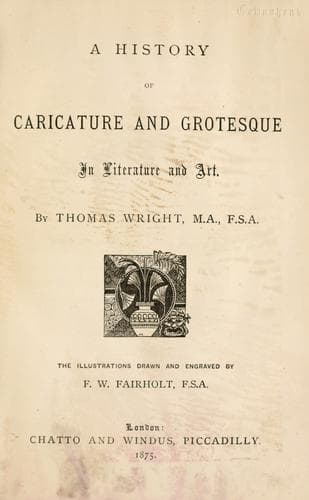
A History of Caricature and Grotesque in Literature and ArtWright, Thomas
History
A History of Caricature and Grotesque in Literature and Art
Wright, Thomas
Caricature -- History
of Treves, in 1227, forbade "all priests to permit truants, or other
wandering scholars, or goliards, to sing verses or _Sanctus_ and
_Angelus Dei_ in the service of the mass."[43] This probably refers to
parodies on the religious service, such as those of which I shall soon
have to speak. From this time the goliards are frequently mentioned. In
ecclesiastical statutes published in the year 1289, it is ordered that
the clerks or clergy (_clerici_, that is, men who had their education
in the university) "should not be jougleurs, goliards, or buffoons;"[44]
and the same statute proclaims a heavy penalty against those _clerici_
"who persist in the practice of goliardy or stage performance during a
year,"[45] which shows that they exercised more of the functions of the
jougleur than the mere singing of songs.
[42] In the mediæval Latin, the word _goliardia_ was introduced to
express the profession of the goliard, and the verb
_goliardizare_, to signify the practice of it.
[43] "Item, præcipimus ut omnes sacerdotes non permittant trutannos et
alios vagos scholares, aut goliardos, cantare versus super
_Sanctus_ et _Angelus Dei_ in missis," etc.--Concil. Trevir.,
an. 1227, ap. Marten. et Durand. Ampliss. Coll., vii. col. 117.
[44] "Item, præcipimus quod clerici non sint joculatores, goliardi, seu
bufones."--Stat. Synod. Caduacensis, Ruthenensis, et Tutelensis
Eccles. ap. Martene, Thes. Anecd., iv. col. 727.
[45] "Clerici ... si in goliardia vel histrionatu per annum
fuerint."--Ib. col. 729. In one of the editions of this statute it
is added, "after they have been warned three times."
These vagabond clerks made for themselves an imaginary chieftain,
or president of their order, to whom they gave the name of Golias,
probably as a pun on the name of the giant who combated against David,
and, to show further their defiance of the existing church government,
they made him a bishop--_Golias episcopus_. Bishop Golias was the
burlesque representative of the clerical order, the general satirist,
the reformer of eclesiastical and all other corruptions. If he was not
a doctor of divinity, he was a master of arts, for he is spoken of as
_Magister Golias_. But above all he was the father of the Goliards,
the "ribald clerks," as they are called, who all belonged to his
household,[46] and they are spoken of as his children.
_Summa salus omnium, filius Mariæ,
Pascat, potat, vestiat pueros Golyæ!_[47]
"May the Saviour of all, the Son of Mary, give food, drink, and clothes
to the children of Golias!" Still the name was clothed in so much
mystery, that Giraldus Cambrensis, who flourished towards the latter
end of the twelfth century, believed Golias to be a real personage,
and his contemporary. It may be added that Golias not only boasts of
the dignity of bishop, but he appears sometimes under the title of
_archipoeta_, the archpoet or poet-in-chief.
Public-domain text, read in full here on John Shaqi.
Reviews
Reviews
No reviews yet
Be the first to share your thoughts on this work.
Elsewhere in the archive
Join the Discussion
Join the discussion
Sign in to leave a comment or review.
Sign InorCreate an account