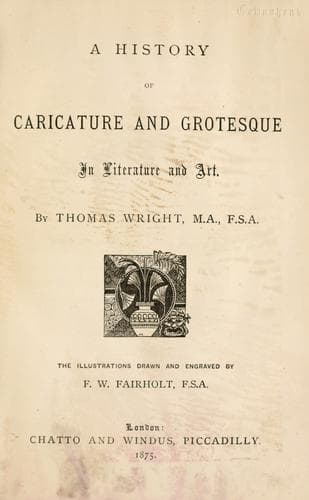
A History of Caricature and Grotesque in Literature and ArtWright, Thomas
History
A History of Caricature and Grotesque in Literature and Art
Wright, Thomas
Caricature -- History
[46] "Clerici ribaldi, maxime qui vulgo dicuntur _de famila
Goliæ_."--Concil. Sen. ap. Concil., tom. ix. p. 578.
[47] See my "Poems of Walter Mapes," p. 70.
Cæsarius of Heisterbach, who completed his book of the miracles of his
time in the year 1222, tells us a curious anecdote of the character
of the wandering clerk. In the year before he wrote, he tells us, "It
happened at Bonn, in the diocese of Cologne, that a certain wandering
clerk, named Nicholas, of the class they call archpoet, was grievously
ill, and when he supposed that he was dying, he obtained from our
abbot, through his own pleading, and the intercession of the canons
of the same church, admission into the order. What more? He put on
the tunic, as it appeared to us, with much contrition, but, when the
danger was past, he took it off immediately, and, throwing it down with
derision, took to flight." We learn best the character of the goliards
from their own poetry, a considerable quantity of which is preserved.
They wandered about from mansion to mansion, probably from monastery
to monastery, just like the jougleurs, but they seem to have been
especially welcome at the tables of the prelates of the church, and,
like the jougleurs, besides being well feasted, they received gifts of
clothing and other articles. In few instances only were they otherwise
than welcome, as described in the rhyming epigram printed in my "Latin
Poems attributed to Walter Mapes." "I come uninvited," says the goliard
to the bishop, "ready for dinner; such is my fate, never to dine
invited." The bishop replies, "I care not for vagabonds, who wander
among the fields, and cottages, and villages; such guests are not for
my table. I do not invite you, for I avoid such as you; yet without my
will you may eat the bread you ask. Wash, wipe, sit, dine, drink, wipe,
and depart."
Goliardus.
_Non invitatus venio prandere paratus;
Sic sum fatatus, nunquam prandere vocatus._
Episcopus.
_Non ego curo vagos, qui rura, mapalia, pagos
Perlustrant, tales non vult mea mensa sodales.
Te non invito, tibi consimiles ego vito;
Me tamen invito potieris pane petito.
Ablue, terge, sede, prande, bibe, terge, recede._
Public-domain text, read in full here on John Shaqi.
Reviews
Reviews
No reviews yet
Be the first to share your thoughts on this work.
Elsewhere in the archive
Join the Discussion
Join the discussion
Sign in to leave a comment or review.
Sign InorCreate an account