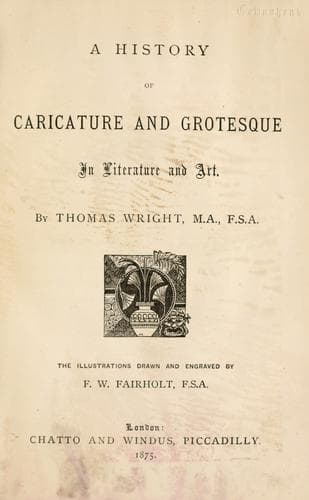
A History of Caricature and Grotesque in Literature and ArtWright, Thomas
History
A History of Caricature and Grotesque in Literature and Art
Wright, Thomas
Caricature -- History
The bishop is in haste to intrude himself into other people's pastures,
and fills himself with other people's goods. The ravenous archdeacon
is compared to an eagle, because he has sharp eyes to see his prey
afar off, and is swift to seize upon it. The dean is represented by an
animal with a man's face, full of silent guile, who covers fraud with
the form of justice, and by the show of simplicity would make others
believe him to be pious. In this spirit the faults of the clergy, of
all degrees, are minutely criticised through between four and five
hundred lines; and it must not be forgotten that it was the English
clergy whose character was thus exposed.
_Tu scribes etiam, forma sed alia,
Septem ecclesiis quæ sunt in Anglia._
Others of these pieces are termed Sermons, and are addressed, some to
the bishops and dignitaries of the church, others to the pope, others
to the monastic orders, and others to the clergy in general. The court
of Rome, we are told, was infamous for its greediness; there all right
and justice were put up for sale, and no favour could be had without
money. In this court money occupies everybody's thoughts; its cross--i.
e. the mark on the reverse of the coin--its roundness, and its
whiteness, all please the Romans; where money speaks law is silent.
_Nummis in hac curia non est qui non vacet;
Crux placet, rotunditas, et albedo placet,
Et cum totum placeat, et Romanis placet,
Ubi nummus loquitur, et lex omnis tacet._
Perhaps one of the most curious of these poems is the "Confession of
Golias," in which the poet is made to satirise himself, and he thus
gives us a curious picture of the goliard's life. He complains that
he is made of light material, which is moved by every wind; that he
wanders about irregularly, like the ship on the sea or the bird in the
air, seeking worthless companions like himself. He is a slave to the
charms of the fair sex. He is a martyr to gambling, which often turns
him out naked to the cold, but he is warmed inwardly by the inspiration
of his mind, and he writes better poetry than ever. Lechery and
gambling are two of his vices, and the third is drinking. "The tavern,"
he says, "I never despised, nor shall I ever despise it, until I see
the holy angels coming to sing the eternal requiem over my corpse. It
is my design to die in the tavern; let wine be placed to my mouth when
I am expiring, that when the choirs of angels come, they may say, 'Be
God propitious to this drinker!' The lamp of the soul is lighted with
cups; the heart steeped in nectar flies up to heaven; and the wine in
the tavern has for me a better flavour than that which the bishop's
butler mixes with water.... Nature gives to every one his peculiar
gift: I never could write fasting; a boy could beat me in composition
when I am hungry; I hate thirst and fasting as much as death."
Public-domain text, read in full here on John Shaqi.
Reviews
Reviews
No reviews yet
Be the first to share your thoughts on this work.
Elsewhere in the archive
Join the Discussion
Join the discussion
Sign in to leave a comment or review.
Sign InorCreate an account