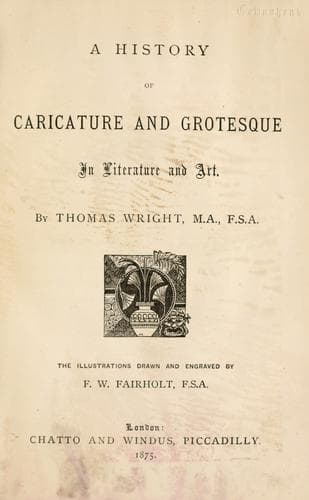
A History of Caricature and Grotesque in Literature and ArtWright, Thomas
History
A History of Caricature and Grotesque in Literature and Art
Wright, Thomas
Caricature -- History
_Tertio capitulo memoro tabernam:
Illam nullo tempore sprevi, neque spernam,
Donec sanctos angelos venientes cernam,
Cantantes pro mortuo requiem æternam._
_Meum est propositum in taberna mori;
Vindum sit appositum morientis ori,
Ut dicant cum venerint angelorum chori,
'Deus sit propitius huic potatori!'_
_Poculis accenditur animi lucerna;
Cor imbutum nectare volat ad superna:
Mihi sapit dulcius vinum in taberna,
Quam quod aqua miscuit præsulis pincerna._
_Unicuique proprium dat natura munus:
Ego nunquam potui scribere jejunus;
Me jejunum vincere posset puer unus;
Sitim et jejunium odi tanquam funus._[51]
Another of the more popular of these goliardic poems was the advice of
Golias against marriage, a gross satire upon the female sex. Contrary
to what we might perhaps expect from their being written in Latin, many
of these metrical satires are directed against the vices of the laity,
as well as against those of the clergy.
[51] Poems attributed to Walter Mapes, p. 73. The stanzas here quoted,
with some others, were afterwards made up into a drinking song,
which was rather popular in the fifteenth and sixteenth centuries.
In 1844 the celebrated German scholar, Jacob Grimm, published in the
"Transactions of the Academy of Sciences at Berlin" a selection of
goliardic verses from manuscripts in Germany, which had evidently been
written by Germans, and some of them containing allusions to German
affairs in the thirteenth century.[52] They present the same form of
verse and the same style of satire as those found in England, but the
name of Golias is exchanged for _archipoeta_, the archpoet. Some of
the stanzas of the "Confession of Golias" are found in a poem in which
the archpoet addresses a petition to the archchancellor for assistance
in his distress, and confesses his partiality for wine. A copy of the
Confession itself is also found in this German collection, under the
title of the "Poet's Confession."
[52] "Gedichte des Mittelalters auf König Friedrich I. den Staufar, und
aus seiner so wie der nächstfolgenden Zeit," 4to. Separate copies
of this work were printed off and distributed among mediæval
scholars.
Public-domain text, read in full here on John Shaqi.
Reviews
Reviews
No reviews yet
Be the first to share your thoughts on this work.
Elsewhere in the archive
Join the Discussion
Join the discussion
Sign in to leave a comment or review.
Sign InorCreate an account