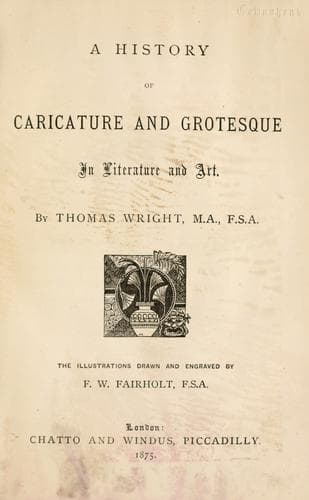
A History of Caricature and Grotesque in Literature and ArtWright, Thomas
History
A History of Caricature and Grotesque in Literature and Art
Wright, Thomas
Caricature -- History
[53] "Carmina Burana. Lateinische und Deutsche Lieder und Gedichte
einer Handschrift des XIII. Jahrhunderts aus Benedictbeurn auf
der K. Bibliothek zu München." 8vo. Stuttgart, 1847.
[54] "Early Mysteries and other Latin Poems of the Twelfth and
Thirteenth Centuries," edited by Thomas Wright, Esq. 8vo. London,
1838.
The goliards did not always write in verse, for we have some of
their prose compositions, and these appear especially in the form
of parodies. We trace a great love for parody in the middle ages,
which spared not even things the most sacred, and the examples
brought forward in the celebrated trial of William Hone, were mild in
comparison to some which are found scattered here and there in mediæval
manuscripts. In my Poems, attributed to Walter Mapes,[55] I have
printed a satire in prose entitled "_Magister Golyas de quodam abbate_"
(i.e., Master Golias's account of a certain abbot), which has somewhat
the character of a parody upon a saint's legend. The voluptuous life of
the superior of a monastic house is here described in a tone of banter
which nothing could excel. Several parodies, more direct in their
character, are printed in the two volumes of the "Reliquæ Antiquæ."[56]
One of these (vol. ii. p. 208) is a complete parody on the service of
the mass, which is entitled in the original, "_Missa de Potatoribus_,"
the Mass of the Drunkard. In this extraordinary composition, even the
pater-noster is parodied. A portion of this, with great variations, is
found in the German collection of the Carmina Burana, under the title
of _Officium Lusorum_, the Office of the Gamblers. In the "Reliquæ
Antiquæ" (ii. 58) we have a parody on the Gospel of St. Luke, beginning
with the words, _Initium fallacis Evangelii secundum Lupum_, this last
word being, of course, a sort of pun upon Lucam. Its subject also is
Bacchus, and the scene having been laid in a tavern in Oxford, we have
no difficulty in ascribing it to some scholar of that university in the
thirteenth century. Among the Carmina Burana we find a similar parody
on the Gospel of St. Mark, which has evidently belonged to one of these
burlesques on the church service; and as it is less profane than the
others, and at the same time pictures the mediæval hatred towards the
church of Rome, I will give a translation of it as an example of this
singular class of compositions. It is hardly necessary to remind the
reader that a mark was a coin of the value of thirteen shillings and
fourpence:--
Public-domain text, read in full here on John Shaqi.
Reviews
Reviews
No reviews yet
Be the first to share your thoughts on this work.
Elsewhere in the archive
Join the Discussion
Join the discussion
Sign in to leave a comment or review.
Sign InorCreate an account