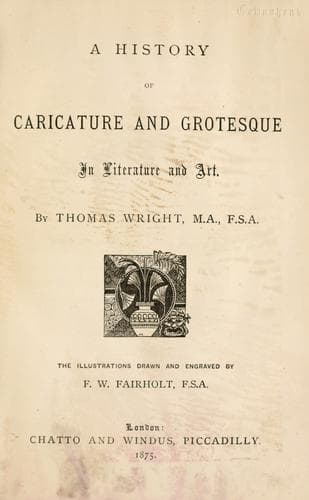
A History of Caricature and Grotesque in Literature and ArtWright, Thomas
History
A History of Caricature and Grotesque in Literature and Art
Wright, Thomas
Caricature -- History
The Royal Library at Munich contains a very important manuscript of
this goliardic Latin poetry, written in the thirteenth century. It
belonged originally to one of the great Benedictine abbeys in Bavaria,
where it appears to have been very carefully preserved, but still
with an apparent consciousness that it was not exactly a book for a
religious brotherhood, which led the monks to omit it in the catalogue
of their library, no doubt as a book the possession of which was not
to be proclaimed publicly. When written, it was evidently intended
to be a careful selection of the poetry of this class then current.
One part of it consists of poetry of a more serious character, such
as hymns, moral poems, and especially satirical pieces. In this class
there are more than one piece which are also found in the manuscripts
written in England. A very large portion of the collection consists
of love songs, which, although evidently treasured by the Benedictine
monks, are sometimes licentious in character. A third class consists
of drinking and gambling songs (_potatoria et lusoria_). The general
character of this poetry is more playful, more ingenious and intricate
in its metrical structure, in fact, more lyric than that of the poetry
we have been describing; yet it came, in all probability, from the same
class of poets--the clerical jougleurs. The touches of sentiment, the
descriptions of female beauty, the admiration of nature, are sometimes
expressed with remarkable grace. Thus, the green wood sweetly enlivened
by the joyous voices of its feathered inhabitants, the shade of its
branches, the thorns covered with flowers, which, says the poet, are
emblematical of love, which pricks like a thorn and then soothes like a
flower, are tastefully described in the following lines:--
_Cantu nemus avium
Lascivia canentium
Suave delinitur,
Fronde redimitur,
Vernant spinæ floribus
Micantibus,
Venerem signantibus
Quia spina pungit, flos blanditur._
And the following scrap of the description of a beautiful damsel shows
no small command of language and versification--
_Allicit dulcibus
Verbis et osculis,
Labellulis
Castigate tumentibus,
Roseo nectareus
Odor infusus ori;
Pariter eburneus
Sedat ordo dentium
Par niveo candori._
The whole contents of this manuscript were printed in 1847, in an
octavo volume, issued by the Literary Society at Stuttgard.[53] I had
already printed some examples of such amatory Latin lyric poetry in
1838, in a volume of "Early Mysteries and Latin Poems;"[54] but this
poetry does not belong properly to the subject of the present volume,
and I pass on from it.
Public-domain text, read in full here on John Shaqi.
Reviews
Reviews
No reviews yet
Be the first to share your thoughts on this work.
Elsewhere in the archive
Join the Discussion
Join the discussion
Sign in to leave a comment or review.
Sign InorCreate an account