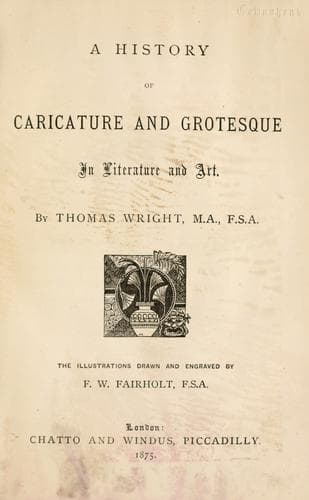
A History of Caricature and Grotesque in Literature and ArtWright, Thomas
History
A History of Caricature and Grotesque in Literature and Art
Wright, Thomas
Caricature -- History
We trace little of this class of literature during the reign of Edward
I.; but, when the popular feelings became turbulent again under the
reign of his son and successor, political songs became more abundant,
and their satire was directed more even than formerly against measures
and principles, and was less an instrument of mere personal abuse. One
satirical poem of this period, which I had printed from an imperfect
copy in a manuscript at Edinburgh, but of which a more complete copy
was subsequently found in a manuscript in the library of St. Peter's
College, Cambridge,[64] is extremely curious as being the earliest
satire of this kind written in English that we possess. It appears to
have been written in the year 1320. The writer of this poem begins by
telling us that his object is to explain the cause of the war, ruin,
and manslaughter which then prevailed throughout the land, and why
the poor were suffering from hunger and want, the cattle perished in
the field, and the corn was dear. These he ascribes to the increasing
wickedness of all orders of society. To begin with the church, Rome
was the head of all corruptions, at the papal court false-hood and
treachery only reigned, and the door of the pope's palace was shut
against truth. During the twelfth and following centuries these
complaints, in terms more or less forcible, against the corruptions of
Rome, are continually repeated, and show that the evil must have been
one under which everybody felt oppressed. The old charge of Romish
simony is repeated in this poem in very strong terms. "The clerk's
voice shall be little heard at the court of Rome, were he ever so good,
unless he bring silver with him; though he were the holiest man that
ever was born, unless he bring gold or silver, all his time and anxiety
are lost. Alas! why love they so much that which is perishable?"
_Voys of clerk shall lytyl be heard at the court of Rome,
Were he never so gode a clerk, without silver and he come;
Though he were the holyst man that ever yet was ibore,
But he bryng gold or sylver, al hys while is forlore
And his thowght.
Allas! whi love thei that so much that schal turne to nowght?_
[64] "A Poem on the Times of Edward III., from a MS. preserved in the
Library of St. Peter's College, Cambridge." Edited by the Rev.
C. Hardwick. 8vo. London, 1849. (One of the publications of the
Percy Society.)
Public-domain text, read in full here on John Shaqi.
Reviews
Reviews
No reviews yet
Be the first to share your thoughts on this work.
Elsewhere in the archive
Join the Discussion
Join the discussion
Sign in to leave a comment or review.
Sign InorCreate an account