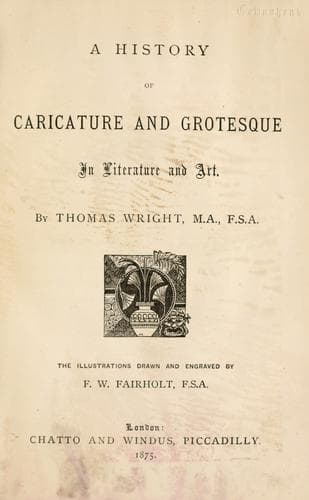
A History of Caricature and Grotesque in Literature and ArtWright, Thomas
History
A History of Caricature and Grotesque in Literature and Art
Wright, Thomas
Caricature -- History
When, on the contrary, a wicked man presented himself at the pope's
court, he had only to carry plenty of money thither, and all went well
with him. According to our satirist, the bishops were "fools," and the
other dignitaries and officials of the church were influenced chiefly
by the love of money and self-indulgence. The parson began humbly, when
he first obtained his benefice, but no sooner had he gathered money
together, than he took "a wenche" to live with him as his wife, and
rode a hunting with hawks and hounds like a gentleman. The priests were
men with no learning, who preached by rote what they neither understood
nor appreciated. "Truely," he says, "it fares by our unlearned priests
as by a jay in a cage, who curses himself: he speaks good English, but
he knows not what it means. No more does an unlearned priest know his
gospel that he reads daily. An unlearned priest, then, is no better
than a jay."
_Certes at so hyt fareth by a prest that is lewed,
As by a jay in a cage that hymself hath beshrewed:
Gode Englysh he speketh, but he not never what.
No more wot a lewed prest hys gospel wat he rat
By day.
Than is a lewed prest no better than a jay._
Abbots and priors were remarkable chiefly for their pride and luxury,
and the monks naturally followed their examples. Thus was religion
debased everywhere. The character of the physician is treated with
equal severity, and his various tricks to obtain money are amusingly
described. In this manner the songster presents to view the failings of
the various orders of lay society also, the selfishness and oppressive
bearing of the knights and aristocracy, and their extravagance in
dress and living, the neglect of justice, the ill-management of the
wars, the weight of taxation, and all the other evils which then
afflicted the state. This poem marks a period in our social history,
and led the way to that larger work of the same character, which
came about thirty years later, the well-known "Visions of Piers
Ploughman,"[65] one of the most remarkable satires, as well as one of
the most remarkable poems, in the English language.
Public-domain text, read in full here on John Shaqi.
Reviews
Reviews
No reviews yet
Be the first to share your thoughts on this work.
Elsewhere in the archive
Join the Discussion
Join the discussion
Sign in to leave a comment or review.
Sign InorCreate an account