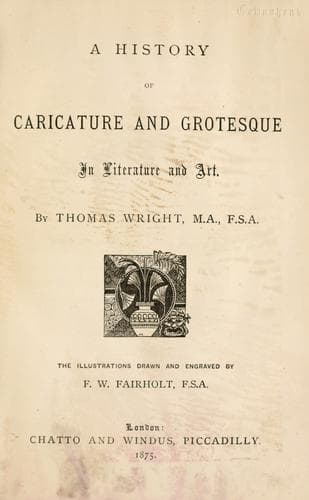
A History of Caricature and Grotesque in Literature and ArtWright, Thomas
History
A History of Caricature and Grotesque in Literature and Art
Wright, Thomas
Caricature -- History
One of the principal classes of the satirists of the middle ages, the
minstrels, or jougleurs, were far from being unamenable to satire
themselves. They belonged generally to a low class of the population,
one that was hardly acknowledged by the law, which merely administered
to the pleasures and amusements of others, and, though sometimes
liberally rewarded, they were objects rather of contempt than of
respect. Of course there were minstrels belonging to a class more
respectable than the others, but these were comparatively few; and the
ordinary minstrel seems to have been simply an unprincipled vagabond,
who hardly possessed any settled resting-place, who wandered about from
place to place, and was not too nice as to the means by which he gained
his living--perhaps fairly represented by the street minstrel, or
mountebank, of the present day. One of his talents was that of mocking
and ridiculing others, and it is not to be wondered at, therefore, if
he sometimes became an object of mockery and ridicule himself. One of
the well-known minstrels of the thirteenth century, Rutebeuf, was, like
many of his fellows, a poet also, and he has left several short pieces
of verse descriptive of himself and of his own mode of life. In one
of these he complains of his poverty, and tells us that the world had
in his time--the reign of St. Louis--become so degenerate, that few
people gave anything to the unfortunate minstrel. According to his own
account, he was without food, and in a fair way towards starvation,
exposed to the cold without sufficient clothing, and with nothing but
straw for his bed.
_Je touz de froit, de fain baaille,
Dont je suis mors et maubailliz,
Je suis sanz coutes et sans liz;
N'a si povre jusqu'à Senliz.
Sire, si ne sai quel part aille;
Mes costeiz connoit le pailliz,
Et liz de paille n'est pas liz,
Et en mon lit n'a fors la paille._
--Œuvres de Rutebeuf, vol. i. p. 3.
In another poem, Rutebeuf laments that he has rendered his condition
still more miserable by marrying, when he had not wherewith to keep
a wife and family. In a third, he complains that in the midst of his
poverty, his wife has brought him a child to increase his domestic
expenses, while his horse, on which he was accustomed to travel to
places where he might exercise his profession, had broken its leg, and
his nurse was dunning him for money. In addition to all these causes of
grief, he had lost the use of one of his eyes.
_Or a d'enfant géu ma fame;
Mon cheval a brisié la jame
A une lice;
Or veut de l'argent ma norrice,
Qui m'en destraint et me pélice,
For l'enfant pestre._
Public-domain text, read in full here on John Shaqi.
Reviews
Reviews
No reviews yet
Be the first to share your thoughts on this work.
Elsewhere in the archive
Join the Discussion
Join the discussion
Sign in to leave a comment or review.
Sign InorCreate an account