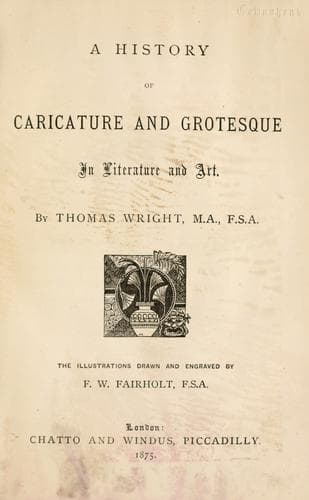
A History of Caricature and Grotesque in Literature and ArtWright, Thomas
History
A History of Caricature and Grotesque in Literature and Art
Wright, Thomas
Caricature -- History
_De asino bono nostro,
Meliori et optimo,
Debemus_ faire fête.
En revenant _de Gravinaria_,
Un gros chardon _reperit in via_,
Il lui coupa la tête.
_Vir monachus in mense Julio
Egressus est e monasterio_,
C'est dom de la Bucaille;
_Egressus est sine licentia_,
Pour aller voir dona Venissia,
Et faire la ripaille.
TRANSLATION.
_For our good ass,
The better and the best,
We ought to rejoice.
In returning from Gravinière,
A great thistle he found in the way,
He cut off its head._
_A monk in the month of July
Went out of his monastery,
It is dom de la Bucaille;
He went out without license,
To pay a visit to the dame de Venisse,
And make jovial cheer._
It appears that De la Bucaille was the prior of the abbey of St.
Taurin, at Rouen, and that the dame de Venisse was prioress of St.
Saviour, and these lines, no doubt, commemorate some great scandal of
the day relating to the private relations between these two individuals.
These mock religious ceremonies are supposed to have been derived from
the Roman Saturnalia; they were evidently of great antiquity in the
mediæval church, and were most prevalent in France and Italy. Under the
name of "the feast of the sub-deacons" they are forbidden by the acts
of the council of Toledo, in 633; at a later period, the French punned
on the word _sous-diacres_, and called them _Saouls-diacres_ (Drunken
Deacons), words which had nearly the same sound. The "feast of the
ass" is said to be traced back in France as far as the ninth century.
It was celebrated in most of the great towns in that country, such as
Rouen, Sens, Douai, &c., and the service for the occasion is actually
preserved in some of the old church books. From this it appears that
the ass was led in procession to a place in the middle of the church,
which had been decked out to receive it, and that the procession was
led by two clerks, who sung a Latin song in praise of the animal. This
song commences by telling us how "the ass came from the east, handsome
and very strong, and most fit for carrying burthens":--
_Orientis partibus
Adventavit asinus,
Pulcher et fortissimus,
Sarcinis aptissimus._
The refrain or burthen of the song is in French, and exhorts the animal
to join in the uproar--"Eh! sir ass, chant now, fair mouth, bray, you
shall have hay enough, and oats in abundance:"--
Public-domain text, read in full here on John Shaqi.
Reviews
Reviews
No reviews yet
Be the first to share your thoughts on this work.
Elsewhere in the archive
Join the Discussion
Join the discussion
Sign in to leave a comment or review.
Sign InorCreate an account