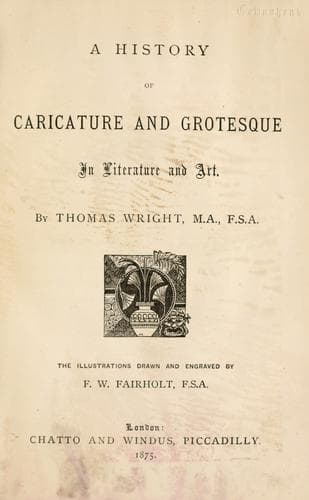
A History of Caricature and Grotesque in Literature and ArtWright, Thomas
History
A History of Caricature and Grotesque in Literature and Art
Wright, Thomas
Caricature -- History
_Hez, sire asnes, car chantez,
Belle bouche, rechignez,
Vous aurez du foin assez,
Et de l'avoine à plantez._
In this tone the chant continues through nine similar stanzas,
describing the mode of life and food of the ass. When the procession
reached the altar, the priest began a service in prose. Beleth, one
of the celebrated doctors of the university of Paris, who flourished
in 1182, speaks of the "feast of fools" as in existence in his time;
and the acts of the council of Paris, held in 1212, forbid the
presence of archbishops and bishops, and more especially of monks and
nuns, at the feasts of fools, "in which a staff was carried."[70] We
know the proceedings of this latter festival rather minutely from
the accounts given in the ecclesiastical censures. It was in the
cathedral churches that they elected the archbishop or bishop of
fools, whose election was confirmed, and he was consecrated, with a
multitude of buffooneries. He then entered upon his pontifical duties
wearing the mitre and carrying the crosier before the people, on whom
he bestowed his solemn benediction. In the exempt churches, or those
which depended immediately upon the Holy See, they elected a pope of
fools (_unum papam fatuorum_), who wore similarly the ensigns of the
papacy. These dignitaries were assisted by an equally burlesque and
licentious clergy, who uttered and performed a mixture of follies and
impieties during the church service of the day, which they attended in
disguises and masquerade dresses. Some wore masks, or had their faces
painted, and others were dressed in women's clothing, or in ridiculous
costumes. On entering the choir, they danced and sang licentious songs.
The deacons and sub-deacons ate black puddings and sausages on the
altar while the priest was celebrating; others played at cards or dice
under his eyes; and others threw bits of old leather into the censer
in order to raise a disagreeable smell. After the mass was ended, the
people broke out into all sorts of riotous behaviour in the church,
leaping, dancing, and exhibiting themselves in indecent postures, and
some went as far as to strip themselves naked, and in this condition
they were drawn through the streets with tubs full of ordure and filth,
which they threw about at the mob. Every now and then they halted,
when they exhibited immodest postures and actions, accompanied with
songs and speeches of the same character. Many of the laity took part
in the procession, dressed as monks and nuns. These disorders seem to
have been carried to their greatest degree of extravagance during the
fourteenth and fifteenth centuries.[71]
[70] "A festis follorum ubi baculus accipitur omnino abstineatur....
Idem fortius monachis et monialibus prohibemus."
Public-domain text, read in full here on John Shaqi.
Reviews
Reviews
No reviews yet
Be the first to share your thoughts on this work.
Elsewhere in the archive
Join the Discussion
Join the discussion
Sign in to leave a comment or review.
Sign InorCreate an account