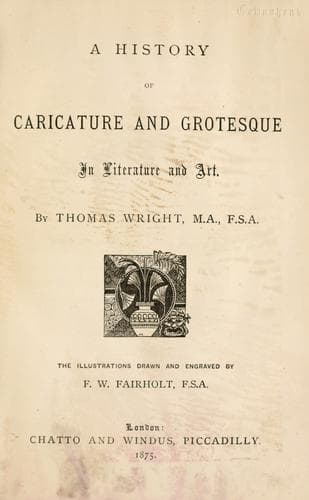
A History of Caricature and Grotesque in Literature and ArtWright, Thomas
History
A History of Caricature and Grotesque in Literature and Art
Wright, Thomas
Caricature -- History
entered their new council-hall, what was their consternation to find
themselves in perfect darkness! In fact, they had forgotten to make
any windows. Another council was held, and one who had been among the
wisest in the days of their wisdom, gave his opinion very oracularly;
the result of which was that they should experiment on every possible
expedient for introducing light into the hall, and that they should
first try that which seemed most likely to succeed. They had observed
that the light of day was caused by sunshine, and the plan proposed was
to meet at mid-day when the sun was brightest, and fill sacks, hampers,
jugs, and vessels of all kinds, with sunshine and daylight, which they
proposed afterwards to empty into the unfortunate council-hall. Next
day, as the clock struck one, you might see a crowd of Schildburgers
before the council-house door, busily employed, some holding the sacks
open, and others throwing the light into them with shovels and any
other appropriate implements which came to hand. While they were thus
labouring, a stranger came into the town of Schildburg, and, hearing
what they were about, told them they were labouring to no purpose,
and offered to show them how to get the daylight into the hall. It is
unnecessary to say more than that this new plan was to make an opening
in the roof, and that the Schildburgers witnessed the effect with
astonishment, and were loud in their gratitude to their new comer.
The Schildburgers met with further difficulties before they completed
their council-hall. They sowed a field with salt, and when the
salt-plant grew up next year, after a meeting of the council, at
which it was stiffly disputed whether it ought to be reaped, or mowed,
or gathered in in some other manner, it was finally discovered that
the crop consisted of nothing but nettles. After many accidents of
this kind, the Schildburgers are noticed by the emperor, and obtain a
charter of incorporation and freedom, but they profit little by it. In
trying some experiments to catch mice, they set fire to their houses,
and the whole town is burnt to the ground, upon which, in their sorrow,
they abandon it altogether, and become, like the Jews of old, scattered
over the world, carrying their own folly into every country they visit.
The earliest known edition of the history of the Schildburgers was
printed in 1597,[75] but the story itself is no doubt older. It will
be seen at once that it involves a satire upon the municipal towns of
the middle ages. A similar series of adventures, only a little more
clerical, bore the title of "Der Pfarrherrn vom Kalenberg," or the
Parson of Kalenberg, and was first, as far as we know, published in the
latter half of the sixteenth century. The first known edition, printed
in 1582, is in prose. Von der Hagen, who reprinted a subsequent edition
in verse, in a volume already quoted, seems to think that in its first
form the story belongs to the fourteenth century.
Public-domain text, read in full here on John Shaqi.
Reviews
Reviews
No reviews yet
Be the first to share your thoughts on this work.
Elsewhere in the archive
Join the Discussion
Join the discussion
Sign in to leave a comment or review.
Sign InorCreate an account