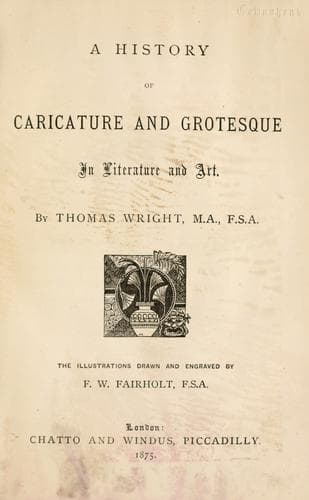
A History of Caricature and Grotesque in Literature and ArtWright, Thomas
History
A History of Caricature and Grotesque in Literature and Art
Wright, Thomas
Caricature -- History
One day twelve men of Gotham went a-fishing, and on their way home they
suddenly discovered that they had lost one of their number, and each
counted in his turn, and could find only eleven. In fact, each forgot
to count himself. In the midst of their distress--for they believed
their companion to be drowned--a stranger approached, and learnt the
cause of their sorrow. Finding they were not to be convinced of their
mistake by mere argument, he offered, on certain conditions, to find
the lost Gothamite, and he proceeded as follows. He took one by one
each of the twelve Gothamites, struck him a hard blow on the shoulder,
which made him scream, and at each cry counted one, two, three, &c.
When it came to twelve, they were all satisfied that the lost Gothamite
had returned, and paid the man for the service he had rendered them.
As a chap-book, this history of the men of Gotham became so popular,
that it gave rise to a host of other books of similar character, which
were compiled at a later period under such titles--formerly well
known to children--as, "The Merry Frolicks, or the Comical Cheats of
Swalpo;" "The Witty and Entertaining Exploits of George Buchanan,
commonly called the King's Fool;" "Simple Simon's Misfortunes;" and the
like. Nor must it be forgotten that the history of Eulenspiegel was
the prototype of a class of popular histories of larger dimensions,
represented in our own literature by "The English Rogue," the work of
Richard Head and Francis Kirkman, in the reign of Charles II., and
various other "rogues" belonging to different countries, which appeared
about that time, or not long afterwards. The earliest of these books
was "The Spanish Rogue, or Life of Guzman de Alfarache," written in
Spanish by Mateo Aleman in the latter part of the sixteenth century.
Curiously enough, some Englishman, not knowing apparently that the
history of Eulenspiegel had appeared in English under the name of
Owlglass, took it into his head to introduce him among the family of
rogues which had thus come into fashion, and, in 1720, published as
"Made English from the High Dutch," what he called "The German Rogue,
or the Life and Merry Adventures, Cheats, Stratagems, and Contrivances
of Tiel Eulespiegle."
Public-domain text, read in full here on John Shaqi.
Reviews
Reviews
No reviews yet
Be the first to share your thoughts on this work.
Elsewhere in the archive
Join the Discussion
Join the discussion
Sign in to leave a comment or review.
Sign InorCreate an account