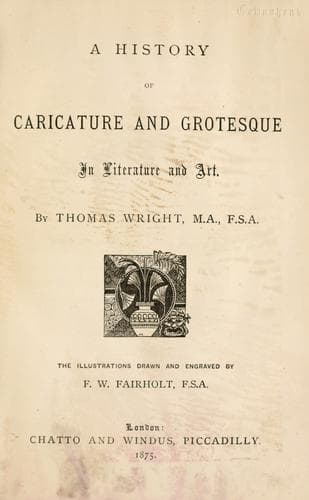
A History of Caricature and Grotesque in Literature and ArtWright, Thomas
History
A History of Caricature and Grotesque in Literature and Art
Wright, Thomas
Caricature -- History
The fifteenth century was the period during which mediæval forms
generally were changing into forms adapted to another state of society,
and in which much of the popular literature which has been in vogue
during modern times took its rise. In the fourteenth century, the
fabliaux of the jougleurs were already taking what we may perhaps term
a more literary form, and were reduced into prose narratives. This
took place especially in Italy, where these prose tales were called
_novelle_, implying some novelty in their character, a word which was
transferred into the French language under the form of _nouvelles_,
and was the origin of our modern English _novel_, applied to a work of
fiction. The Italian novelists adopted the Eastern plan of stringing
these stories together on the slight framework of one general plot,
in which are introduced causes for telling them and persons who tell
them. Thus the Decameron of Boccaccio holds towards the fabliaux
exactly the same position as that of the "Arabian Nights" to the older
Arabian tales. The Italian novelists became numerous and celebrated
throughout Europe, from the time of Boccaccio to that of Straparola,
at the commencement of the sixteenth century, and later. The taste for
this class of literature appears to have been introduced into France at
the court of Burgundy, where, under duke Philippe le Bon, a well-known
courtier and man of letters named Antoine de La Sale, who had, during
a sojourn in Italy, become acquainted with one of the most celebrated
of the earlier Italian collections, the "Cento Novello," or the Hundred
Novels, compiled a collection in French in imitation of them, under the
title of "Les Cent Nouvelles Nouvelles," or the Hundred new Novels,
one of the purest examples of the French language in the fifteenth
century.[76] The later French story-books, such as the Heptameron of
the queen of Navarre, and others, belong chiefly to the sixteenth
century. These collections of stories can hardly be said to have ever
taken root in this island as a part of English literature.
[76] I am obliged to pass over this part of the subject very rapidly.
For the history of that remarkable book, the "Cent Nouvelles
Nouvelles," I would refer the reader to the preface to my own
edition, "Les Cent Nouvelles Nouvelles, publiées d'après le
seul manuscrit connu, avec Introduction et Notes, par M. Thomas
Wright." 2 vols, 12mo., Paris, 1858.
Public-domain text, read in full here on John Shaqi.
Reviews
Reviews
No reviews yet
Be the first to share your thoughts on this work.
Elsewhere in the archive
Join the Discussion
Join the discussion
Sign in to leave a comment or review.
Sign InorCreate an account