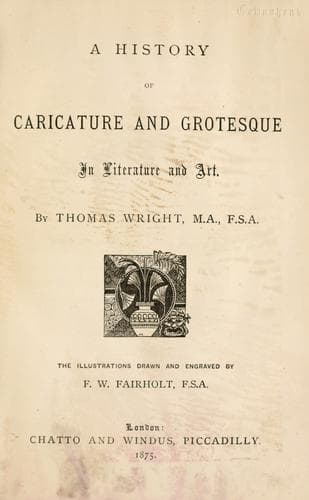
A History of Caricature and Grotesque in Literature and ArtWright, Thomas
History
A History of Caricature and Grotesque in Literature and Art
Wright, Thomas
Caricature -- History
But there arose partly out of these stories a class of books which
became greatly multiplied, and were, during a long period, extremely
popular. With the household fool, or jester, instead of the old
jougleur, the stories had been shorn of their detail, and sank into
the shape of mere witty anecdotes, and at the same time a taste arose
for what we now class under the general term of jests, clever sayings,
what the French call _bons mots_, and what the English of the sixteenth
century termed "quick answers." The word _jest_ itself arose from the
circumstance that the things designated by it arose out of the older
stories, for it is a mere corruption of gestes, the Latin _gesta_, in
the sense of narratives of acts or deeds, or tales. The Latin writers,
who first began to collect them into books, included them under the
general name of _facetiæ_. The earlier of these collections of facetiæ
were written in Latin, and of the origin of the first with which we
are acquainted, that by the celebrated scholar Poggio of Florence,
a curious anecdote is told. Some wits of the court of pope Martin
V., elected to the papacy in 1417, among whom were the pope's two
secretaries, Poggio and Antonio Lusco, Cincio of Rome, and Ruzello of
Bologna, appropriated to themselves a private corner in the Vatican,
where they assembled to chat freely among themselves. They called
it their _buggiale_, a word which signifies in Italian, a place of
recreation, where they tell stories, make jests, and amuse themselves
with discussing satirically the doings and characters of everybody.
This was the way in which Poggio and his friends entertained themselves
in their buggiale, and we are assured that in their talk they neither
spared the church nor the pope himself or his government. The facetiæ
of Poggio, in fact, which are said to be a selection of the good things
said in these meetings, show neither reverence for the church of Rome
nor respect for decency, but they are mostly stories which had been
told over and over again, long before Poggio came into the world. It
was perhaps this satire upon the church and upon the ecclesiastics
which gave much of their popularity to these facetiæ at a time when
a universal agitation of men's minds on religious affairs prevailed,
which was the great harbinger of the Reformation; and the next Latin
books of facetiæ came from men such as Henry Bebelius, who were zealous
reformers themselves.
Many of the jests in these Latin collections are put into the mouths of
jesters, or domestic fools, _fatui_, or _moriones_, as they are called
in the Latin; and in England, where these jest-books in the vernacular
tongue became more popular perhaps than in any other country, many
of them were published under the names of celebrated jesters, as the
"Merie Tales of Skelton," "The Jests of Scogin," "Tarlton's Jests," and
"The Jests of George Peele."
Public-domain text, read in full here on John Shaqi.
Reviews
Reviews
No reviews yet
Be the first to share your thoughts on this work.
Elsewhere in the archive
Join the Discussion
Join the discussion
Sign in to leave a comment or review.
Sign InorCreate an account