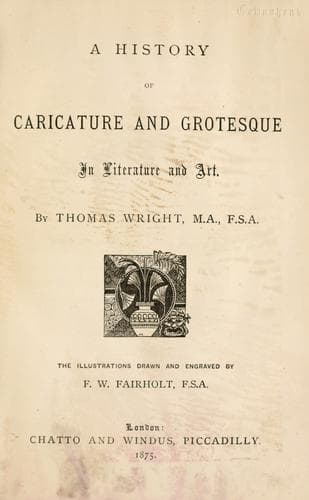
A History of Caricature and Grotesque in Literature and ArtWright, Thomas
History
A History of Caricature and Grotesque in Literature and Art
Wright, Thomas
Caricature -- History
Hrotsvitha, in her preface, complains that, in spite of the general
love for the reading of the Scriptures, and contempt for everything
derived from ancient paganism, people still too often read the
"fictions" of Terence, and thus, seduced by the beauties of his style,
soiled their minds with the knowledge of the criminal acts which are
described in his writings. A rather early manuscript has preserved a
very curious fragment illustrative of the manner in which the comedies
of the Romans were regarded by one class of people in the middle ages,
and it has also a further meaning. Its form is that of a dialogue in
Latin verse between Terence and a personage called in the original
_delusor_, which was no doubt intended to express a performer of some
kind, and may be probably considered as synonymous with _jougleur_. It
is a contention between the new jouglerie of the middle ages and the
old jouglerie of the schools, somewhat in the same style as the fabliau
of "Les deux Troveors Ribauz," described in a former chapter.[80] We
are to suppose that the name of Terence has been in some way or other
brought forward in laudatory terms, upon which the jougleur steps
forward from among the spectators and expresses himself towards the
Roman writer very contemptuously. Terence then makes his appearance to
speak in his own defence, and the two go on abusing one another in no
very measured language. Terence asks his assailant who he is? to which
the other replies, "If you ask who I am, I reply, I am better than
thee. Thou art old and broken with years; I am a tyro, full of vigour,
and in the force of youth. You are but a barren trunk, while I am a
good and fertile tree. If you hold your tongue, old fellow, it will be
much better for you."
_Si rogitas quis sum, respondeo: te melior sum.
Tu vetus atque senex; ego tyro, valens, adulescens.
Tu sterilis truncus; ego fertilis arbor, opimus.
Si taceas, o vetule, lucrum tibi quæris enorme._
Terence replies:--"What sense have you left? Are you, think you,
better than me? Let me see you, young as you are, compose what
I, however old and broken, will compose. If you be a good tree,
show us some proofs of your fertility. Although I may be a barren
trunk, I produce abundance of better fruit than thine."
_Quis tibi sensus inest? numquid melior me es?
Nunc vetus atque senex quæ fecero fac adolescens.
Si bonus arbor ades, qua fertilitate redundas?
Cum sim truncus iners, fructu meliore redundo._
And so the dispute continues, but unfortunately the latter part has
been lost with a leaf or two of the manuscript. I will only add that I
think the age of this curious piece has been overrated.[81]
[80] See p. 191 of the present volume.
Public-domain text, read in full here on John Shaqi.
Reviews
Reviews
No reviews yet
Be the first to share your thoughts on this work.
Elsewhere in the archive
Join the Discussion
Join the discussion
Sign in to leave a comment or review.
Sign InorCreate an account