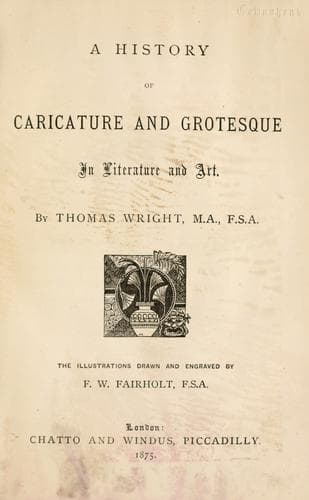
A History of Caricature and Grotesque in Literature and ArtWright, Thomas
History
A History of Caricature and Grotesque in Literature and Art
Wright, Thomas
Caricature -- History
[81] This singular composition was published with notes by M. de
Montaiglon, in a Parisian journal entitled, "L'Amateur de
Livres," in 1849, under the title of "Fragment d'un Dialogue
Latin du ix^e siècle entre Terence et un Bouffon." A few separate
copies were printed, of which I possess one.
Hrotsvitha is the earliest example we have of mediæval writers in this
particular class of literature. We find no other until the twelfth
century, when two writers flourished named Vital of Blois (_Vitalis
Blesensis_) and Matthew of Vendôme (_Matthæus Vindocinensis_), the
authors of several of the mediæval poems distinguished by the title of
_comœdiæ_, which give us a clearer and more distinct idea of what
was meant by the word. They are written in Latin Elegiac verse, a form
of composition which was very popular among the mediæval scholars, and
consist of stories told in dialogue. Hence Professor Osann, of Giessen,
who edited two of those of Vital of Blois, gives them the title of
eclogues (_eclogæ_). The name comedy is, however, given to them in
manuscripts, and it may perhaps admit of the following explanation.
These pieces seem to have been first mere abridgments of the plots of
the Roman comedies, especially those of Plautus, and the authors appear
to have taken the Latin title of the original as applied to the plot,
in the sense of a narrative, and not to its dramatic form. Of the two
"comedies" by Vital of Blois, one is entitled "Geta," and is taken from
the "Amphytrio" of Plautus, and the other, which in the manuscripts
bears the title of "Querulus," represents the "Aulularia" of the
same writer. Independent of the form of composition, the scholastic
writer has given a strangely mediæval turn to the incidents of the
classic story of Jupiter and Alcmena. Another similar "comedy," that
of Babio, which I first printed from the manuscripts, is still more
mediæval in character. Its plot, perhaps taken from a fabliau, for the
mediæval writers rarely invented stories, is as follows, although it
must be confessed that it comes out rather obscurely in the dialogue
itself. Babio, the hero of the piece, is a priest, who, as was still
common at that time (the twelfth century), has a wife, or, as the
strict religionists would then say, a concubine, named Pecula. She has
a daughter named Viola, with whom Babio is in love, and he pursues
his design upon her, of course unknown to his wife. Babio has also a
man-servant named Fodius, who is engaged in a secret intrigue with
his mistress, Pecula, and also seeks to seduce her daughter, Viola.
To crown the whole, the lord of the manor, a knight named Croceus, is
also in love with Viola, though with more honourable designs. Here is
surely intrigue enough and a sufficient absence of morality to satisfy
a modern French novelist of the first water. At the opening of the
piece, amid some by-play between the four individuals who form the
Public-domain text, read in full here on John Shaqi.
Reviews
Reviews
No reviews yet
Be the first to share your thoughts on this work.
Elsewhere in the archive
Join the Discussion
Join the discussion
Sign in to leave a comment or review.
Sign InorCreate an account