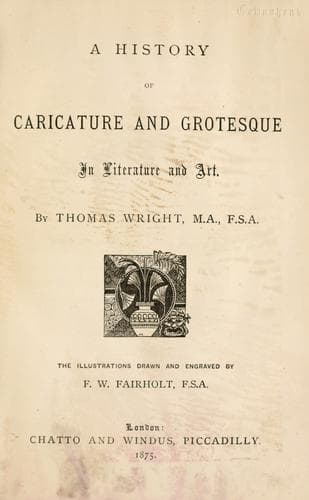
A History of Caricature and Grotesque in Literature and ArtWright, Thomas
History
A History of Caricature and Grotesque in Literature and Art
Wright, Thomas
Caricature -- History
household of Babio, it is suddenly announced that Croceus is on his
way to visit him, and a feast is hastily prepared for his reception.
It ends in the knight carrying away Viola by force. Babio, after a
little vain bluster, consoles himself for the loss of the damsel with
reflections on the virtue of his wife, Pecula, and the faithfulness of
his man, Fodius, when, at this moment, Fame carries to his ear reports
which excite his suspicions against them. He adopts a stratagem very
frequently introduced in the mediæval stories, surprises the two lovers
under circumstances which leave no room for doubting their guilt, and
then forgives them, enters a monastery, and leaves them to themselves.
In form, these "comedies" are little more than scholastic exercises;
but, at a later period, we shall see the same stories adopted as the
subjects of farces.[82]
[82] To judge by the number of copies found in manuscripts,
especially of the "Geta," these dramatic poems must have enjoyed
considerable popularity. The "Geta" and the "Querulus" were
published in a volume entitled, "Vitalis Blesensis Amphitryon et
Aulularia Eclogæ. Edidit Fridericus Osannus, Professor Gisensis,"
8vo., Darmstadt, 1836. The "Geta" and the "Babio" are included
in my "Early Mysteries, and other Latin Poems of the Twelfth and
Thirteenth Centuries."
Already, however, by the side of these dramatic poems, a real
drama--the drama of the middle ages--was gradually developing
itself. As stated before, it arose, like the drama of the Greeks,
out of the religious ceremonies. We know nothing of the existence of
anything approaching to dramatic forms which may have existed among
the religious rites of the peoples of the Teutonic race before
their conversion to Christianity, but the Christian clergy felt the
necessity of keeping up festive religious ceremonies in some form or
other, and also of impressing upon people's imagination and memory by
means of rude scenical representations some of the broader facts of
scriptural and ecclesiastical history. These performances at first
consisted probably in mere dumb show, or at the most the performers
may have chanted the scriptural account of the transaction they were
representing. In this manner the choral boys, or the younger clergy,
would, on some special Saint's day, perform some striking act in
the life of the saint commemorated, or, on particular festivals of
the church, those incidents of gospel history to which the festival
especially related. By degrees, a rather more imposing character was
given to these performances by the addition of a continuous dialogue,
which, however, was written in Latin verse, and was no doubt chanted.
This incipient drama in Latin, as far as we know it, belongs to the
twelfth century, and is represented by a tolerably large number of
examples still preserved in mediæval manuscripts. Some of the earliest
of these have for their author a pupil of the celebrated Abelard, named
Public-domain text, read in full here on John Shaqi.
Reviews
Reviews
No reviews yet
Be the first to share your thoughts on this work.
Elsewhere in the archive
Join the Discussion
Join the discussion
Sign in to leave a comment or review.
Sign InorCreate an account