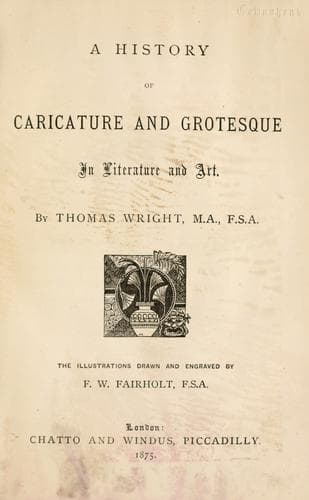
A History of Caricature and Grotesque in Literature and ArtWright, Thomas
History
A History of Caricature and Grotesque in Literature and Art
Wright, Thomas
Caricature -- History
In the English plays now remaining, these scenes are, on the whole,
less frequent, and they are usually more closely connected with
the general subject. The earliest English collection that has been
published is that known as the "Towneley Mysteries," the manuscript of
which belongs to the fifteenth century, and the plays themselves may
have been composed in the latter part of the fourteenth. It contains
thirty-two plays, beginning with the Creation, and ending with the
Ascension and the Day of Judgment, with two supplementary plays, the
"Raising of Lazarus" and the "Hanging of Judas." The play of "Cain and
Abel" is throughout a vulgar drollery, in which Cain, who exhibits
the character of a blustering ruffian, is accompanied by a _garcio_,
or lad, who is the very type of a vulgar and insolent horse-boy, and
the conversation of these two worthies reminds us a little of that
between the clown and his master in the open-air performances of the
old wandering mountebanks. Even the death of Abel by the hand of his
brother is performed in a manner calculated to provoke great laughter.
In the old mirthful spirit, to hear two persons load each other with
vulgar abuse, was as good as seeing them grin through a horse-collar,
if not better. Hence the droll scene in the play of "Noah" is a
domestic quarrel between Noah and his wife, who was proverbially a
shrew, and here gives a tolerable example of abusive language, as it
might then come from a woman's tongue. The quarrel arises out of her
obstinate refusal to go into the ark. In the New Testament series the
play of "The Shepherds" was one of those most susceptible of this sort
of embellishment. There are two plays of the Shepherds in the "Towneley
Mysteries," the first of which is amusing enough, as it represents,
in clever burlesque, the acts and conversation of a party of mediæval
shepherds guarding their flocks at night; but the second play of the
Shepherds is a much more remarkable example of a comic drama. The
shepherds are introduced at the opening of the piece conversing very
satirically on the corruptions of the time, and complaining how the
people were impoverished by over-taxation, to support the pride and
vanity of the aristocracy. After a good deal of very amusing talk, the
shepherds, who, as usual, are three in number, agree to sing a song,
and it is this song, it appears, which brings to them a fourth, named
Mak, who proves to be a sheep-stealer; and, in fact, no sooner have
the shepherds resigned themselves to sleep for the night, than Mak
chooses one of the best sheep in their flocks, and carries it home
to his hut. Knowing that he will be suspected of the theft, and that
he will soon be pursued, he is anxious to conceal the plunder, and
is only helped out of his difficulty by his wife, who suggests that
the carcase shall be laid at the bottom of her cradle, and that she
shall lie upon it and groan, pretending to be in labour. Meanwhile the
Public-domain text, read in full here on John Shaqi.
Reviews
Reviews
No reviews yet
Be the first to share your thoughts on this work.
Elsewhere in the archive
Join the Discussion
Join the discussion
Sign in to leave a comment or review.
Sign InorCreate an account