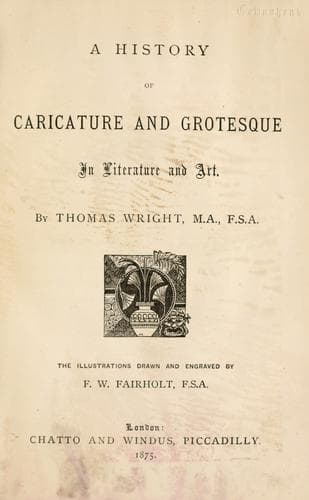
A History of Caricature and Grotesque in Literature and ArtWright, Thomas
History
A History of Caricature and Grotesque in Literature and Art
Wright, Thomas
Caricature -- History
shepherds awake, discover the loss of a sheep, and perceiving that Mak
has disappeared also, they naturally suspect him to be the depredator,
and pursue him. They find everything very cunningly prepared in the
cottage to deceive them, but, after a large amount of roundabout
inquiry and research, and much drollery, they discover that the boy of
which Mak's wife pretends to have been just delivered, is nothing else
but the sheep which had been stolen from their flocks. The wife still
asserts that it is her child, and Mak sets up as his defence that the
baby had been "forspoken," or enchanted, by an elf at midnight, and
that it had thus been changed into the appearance of a sheep; but the
shepherds refuse to be satisfied with this explanation. The whole of
this little comedy is carried out with great skill, and with infinite
drollery. The shepherds, while still wrangling with Mak and his wife,
are seized with drowsiness, and lie down to sleep; but they are aroused
by the voice of the angel, who proclaims the birth of the Saviour. The
next play in which the drollery is introduced, is that of "Herod and
the Slaughter of the Innocents." Herod's bluster and bombast, and the
vulgar abuse which passes between the Hebrew mothers and the soldiers
who are murdering their children, are wonderfully laughable. The plays
which represented the arrest, trial, and execution of Jesus, are all
full of drollery, for the grotesque character which had been given to
the demons in the earlier middle ages, appears to have been transferred
to the executioners, or, as they were called, the "tormentors," and
the language and manner in which they executed their duties, must have
kept the audience in a continual roar of laughter. In the play of
"Doomsday," the fiends retained their old character, and the manner
in which they joke over the distress of the sinful souls, and the
details they give of their sinfulness, are equally mirth-provoking. The
"Coventry Mysteries" are also printed from a manuscript of the middle
of the fifteenth century, and are, perhaps, as old as the "Towneley
Mysteries." They consist of forty-two plays, but they contain, on the
whole, fewer droll scenes than those of the Towneley collection. But
a very remarkable example is furnished in the play of the "Trial of
Joseph and Mary," which is a very grotesque picture of the proceedings
in a mediæval consistory court. The sompnour, a character so well
known by Chaucer's picture of him, opens the piece by reading from his
book a long list of offenders against chastity. At its conclusion,
two "detractors" make their appearance, who repeat various scandalous
stories against the Virgin Mary and her husband Joseph, which are
overheard by some of the high officers of the court, and Mary and
Joseph are formally accused and placed upon their trial. The trial
itself is a scene of low ribaldry, which can only have afforded
amusement to a very vulgar audience. There is a certain amount of the
Public-domain text, read in full here on John Shaqi.
Reviews
Reviews
No reviews yet
Be the first to share your thoughts on this work.
Elsewhere in the archive
Join the Discussion
Join the discussion
Sign in to leave a comment or review.
Sign InorCreate an account