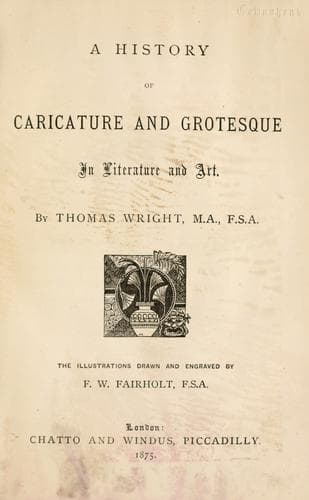
A History of Caricature and Grotesque in Literature and ArtWright, Thomas
History
A History of Caricature and Grotesque in Literature and Art
Wright, Thomas
Caricature -- History
The sotties and moralities were more imaginative and extravagant
than the farces, and were filled with allegorical personages. The
characters introduced in the former have generally some relation to
the kingdom of folly. Thus, in one of the sotties, the king of fools
(_le roy des sotz_) is represented as holding his court, and consulting
with his courtiers, whose names are Triboulet, Mitouflet, Sottinet,
Coquibus, and Guippelin. Their conversation, as may be supposed, is
of a satirical character. Another is entitled "The Sottie of the
Deceivers," or cheats. Sottie--another name for mother Folly--opens
the piece with a proclamation or address to fools of all descriptions,
summoning them to her presence. Two, named Teste-Verte and Fine-Mine,
obey the call, and they are questioned as to their own condition, and
their proceedings, but their conversation is interrupted by the sudden
intrusion of another personage named Everyone (_Chascun_), who, on
examination, is found to be as perfect a fool as any of them. They
accordingly fraternise, and join in a song. Finally, another character,
The Time (_le Temps_), joins them, and they agree to submit to his
directions. Accordingly he instructs them in the arts of flattery
and deceiving, and the other similar means by which men of that time
sought to thrive. Another is the Sottie of Foolish Ostentation (_de
folle bobance_). This lady similarly opens the scene with an address
to all the fools who hold allegiance to her, and three of these make
their appearance. The first fool is the gentleman, the second the
merchant, the fourth the peasant, and their conversation is a satire
on contemporary society. The personification of abstract principles is
far bolder. The three characters who compose one of these moralities
are Everything (_tout_), Nothing (_rien_), and Everyone (_chascun_).
How the personification of Nothing was to be represented, we are not
told. The title of another of these moralities will be enough to give
the reader a notion of their general title; it is, "A New Morality of
the Children of Now-a-Days (_Maintenant_), who are the Scholars of
Once-good (_Jabien_), who shows them how to play at Cards and at Dice,
and to entertain Luxury, whereby one comes to Shame (_Honte_), and
from Shame to Despair (_Desespoir_), and from Despair to the gibbet of
Perdition, and then turns himself to Good-doing." The characters in
this play are Now-a-Days, Once-good, Luxury, Shame, Despair, Perdition,
and Good-doing.
Public-domain text, read in full here on John Shaqi.
Reviews
Reviews
No reviews yet
Be the first to share your thoughts on this work.
Elsewhere in the archive
Join the Discussion
Join the discussion
Sign in to leave a comment or review.
Sign InorCreate an account