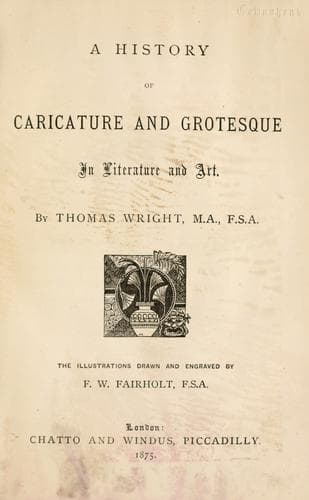
A History of Caricature and Grotesque in Literature and ArtWright, Thomas
History
A History of Caricature and Grotesque in Literature and Art
Wright, Thomas
Caricature -- History
Diccon has still the spirit of mischief in him, and
instead of laying his hand quietly on Hodge's breech, he gives him a
sharp blow, which is responded to by an unexpected scream. The needle,
indeed, which has never quitted the breeches, is driven rather deep
into the fleshy part of Hodge's body, and the general joy at having
found it again overruling all other considerations, they all agree to
be friends over a jug of "drink."
We cannot but feel astonished at the short period which it required
to develop rude attempts at dramatic composition like this into the
wonderful creations of a Shakespeare; and it can only be explained
by the fact that it was an age remarkable for producing men of
extraordinary genius in every branch of intellectual development.
Hitherto, the literature of the stage had represented the intelligence
of the mass; it became individualised in Shakespeare, and this fact
marks an entirely new era in the history of the drama. In the writings
of our great bard, nearly all the peculiarities of the older national
drama are preserved, even some which may be perhaps considered as its
defects, but carried to a degree of perfection which they had never
attained before. The drollery, which, as we have seen, could not be
dispensed with even in the religious mysteries and miracle-plays, had
become so necessary, that it could not be dispensed with in tragedy.
Its omission belonged to a later period, when the foreign dramatists
became objects of imitation in England. But in the earlier drama, these
scenes of drollery seem frequently to have no connection whatever with
the general plot, while Shakespeare always interweaves them skilfully
with it, and they seem to form an integral and necessary part of it.
CHAPTER XVII.
DIABLERIE IN THE SIXTEENTH CENTURY.--EARLY TYPES OF THE DIABOLICAL
FORMS.--ST. ANTHONY.--ST. GUTHLAC.--REVIVAL OF THE TASTE FOR SUCH
SUBJECTS IN THE BEGINNING OF THE SIXTEENTH CENTURY.--THE FLEMISH
SCHOOL OF BREUGHEL.--THE FRENCH AND ITALIAN SCHOOLS, CALLOT,
SALVATOR ROSA.
We have seen how the popular demonology furnished materials for the
earliest exercise of comic art in the middle ages, and how the taste
for this particular class of grotesque lasted until the close of the
mediæval period. After the "renaissance" of art and literature, this
taste took a still more remarkable form, and the school of grotesque
_diablerie_ which flourished during the sixteenth century, and the
first half of the seventeenth, justly claims a chapter to itself.
Public-domain text, read in full here on John Shaqi.
Reviews
Reviews
No reviews yet
Be the first to share your thoughts on this work.
Elsewhere in the archive
Join the Discussion
Join the discussion
Sign in to leave a comment or review.
Sign InorCreate an account