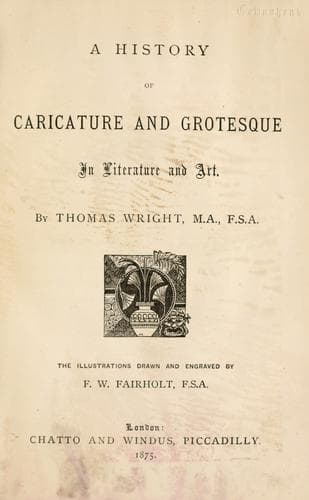
A History of Caricature and Grotesque in Literature and ArtWright, Thomas
History
A History of Caricature and Grotesque in Literature and Art
Wright, Thomas
Caricature -- History
With Bale and with John Heywood, the English plays began to approach
the form of a regular drama, and the two now rather celebrated pieces,
"Ralph Roister Doister," and "Gammer Gurton's Needle," which belong
to the middle of the sixteenth century, may be considered as comedies
rather than as interludes. The former, written by a well-known scholar
of that time, Nicholas Udall, master of Eton, is a satirical picture
of some phases of London life, and relates the ridiculous adventures
of a weak-headed and vain-glorious gallant, who believes that all
the women must be in love with him, and who is led by a needy and
designing parasite named Matthew Merygreeke. Rude as it is as a
dramatic composition, it displays no lack of talent, and it is full
of genuine humour. The humour in "Gammer Gurton's Needle" is none
the less rich because it is of coarser and rather broader cast. The
good dame of the piece, Gammer Gurton, during an interruption in the
process of mending the breeches of her husband, Hodge, has lost her
needle, and much lamentation follows a misfortune so great at a time
when needles appear to have been rare and valuable articles in the
rural household. In the midst of their trouble appears Diccon, who is
described in the _dramatis personæ_ as "Diccon the Bedlam," meaning
that he was an idiot, and who appears to hold the position of Vice in
the play. Diccon, however, though weak-minded, is a cunning fellow, and
especially given to making mischief, and he accuses a neighbour, Dame
Chat, of stealing the needle. At the same time, the same mischievous
individual tells Dame Chat that Gammer Gurton's cock had been stolen in
the night from the henroost, and that she, Dame Chat, was accused of
being the thief. Amid the general misunderstanding which results from
Diccon's successful endeavours, they send for the parson of the parish,
Dr. Rat, who appears to unite in himself the three parts of preacher,
physician, and conjurer, in order to have advantage of his experience
in finding the needle. Diccon now contrives a new piece of mischief.
He persuades Dame Chat that Hodge intends to hide himself in a certain
hole in the premises, in order, that night, to creep out and kill all
her hens; and at the same time he informs Dr. Rat, that if he will
hide in the same hole, he will give him ocular demonstration of Dame
Chat's guilt of stealing the needle. The consequence is that Dame Chat
attacks by surprise, and somewhat violently, the supposed depredator
in the hole, and that Dr. Rat gets a broken head. Dame Chat is brought
before "Master Bayly" for the assault, and the proceedings in the trial
bring to light the deceptions which have been played upon them all,
and Diccon stands convicted as the wicked perpetrator. In fact, the
"bedlam" confesses it all, and it is finally decided by "Master Bayly"
that there shall be a general reconciliation, and that Diccon shall
take a solemn oath on Hodge's breech, that he will do his best to find
the lost needle.
Public-domain text, read in full here on John Shaqi.
Reviews
Reviews
No reviews yet
Be the first to share your thoughts on this work.
Elsewhere in the archive
Join the Discussion
Join the discussion
Sign in to leave a comment or review.
Sign InorCreate an account