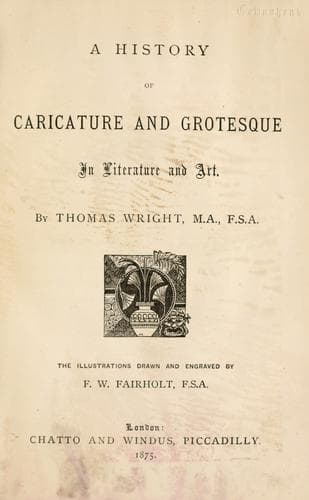
A History of Caricature and Grotesque in Literature and ArtWright, Thomas
History
A History of Caricature and Grotesque in Literature and Art
Wright, Thomas
Caricature -- History
Callot reached Rome at the beginning of the year 1609, and now at
length he joined the friend of his childhood, Israel Henriet, and began
to throw all his energy into his art-labours. It is more than probable
that he studied under Tempesta, with Henriet, who was a pupil of that
painter, and another Lorrainer, Claude Dervet. After a time, Callot
began to feel the want of money, and obtained employment of a French
engraver, then residing in Rome, named Philippe Thomassin, with whom he
worked nearly three years, and became perfect in handling the graver.
Towards the end of the year 1611, Callot went to Florence, to place
himself under Julio Parigi, who then flourished there as a painter and
engraver. Tuscany was at this time ruled by its duke Cosmo de' Medicis,
a great lover of the arts, who took Callot under his patronage, giving
him the means to advance himself. Hitherto his occupation had been
principally copying the works of others, but under Parigi he began to
practise more in original design, and his taste for the grotesque came
upon him stronger than ever. Although Parigi blamed it, he could not
help admiring the talent it betrayed. In 1615, the grand duke gave a
great entertainment to the prince of Urbino, and Callot was employed
to make engravings of the festivities; it was his first commencement
in a class of designs by which he afterwards attained great celebrity.
In the year following, his engagement with Parigi ended, and he became
his own master. He now came out unfettered in his own originality. The
first fruits were seen in a new kind of designs, to which he gave the
name of "Caprices," a series of which appeared about the year 1617,
under the title of "Caprici di varie Figure." Callot re-engraved them
at Nancy in later years, and in the new title they were stated to have
been originally engraved in 1616. In a short preface, he speaks of
these as the first of his works on which he set any value. They now
strike us as singular examples of the fanciful creations of a most
grotesque imagination, but they no doubt preserve many traits of the
festivals, ceremonies, and manners of that land of masquerade, which
must have been then familiar to the Florentines; and these engravings
would, doubtless, be received by them with absolute delight. One is
copied in our cut No. 163; it represents a cripple supporting himself
on a short crutch, with his right arm in a sling. Our cut No. 164 is
another example from the same set, and represents a masked clown, with
his left hand on the hilt of his dagger, or perhaps of a wooden sword.
From this time, although he was very industrious and produced much,
Callot engraved only his own designs.
[Illustration: _No. 163. A Cripple._]
[Illustration: _No. 164. A Grotesque Masker._]
Public-domain text, read in full here on John Shaqi.
Reviews
Reviews
No reviews yet
Be the first to share your thoughts on this work.
Elsewhere in the archive
Join the Discussion
Join the discussion
Sign in to leave a comment or review.
Sign InorCreate an account