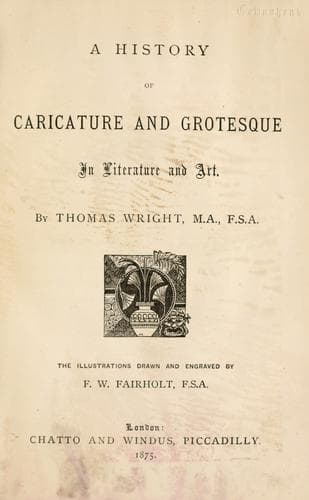
A History of Caricature and Grotesque in Literature and ArtWright, Thomas
History
A History of Caricature and Grotesque in Literature and Art
Wright, Thomas
Caricature -- History
The sixteenth century, especially on the Continent, was a period of
that sort of violent agitation which is most favourable to the growth
of satire. Society was breaking up, and going through a course of
decomposition, and it presented to the view on every side spectacles
which provoked the mockery, perhaps more than the indignation, of
lookers-on. Even the clergy had learnt to laugh at themselves, and
almost at their own religion; and people who thought or reflected were
gradually separating into two classes--those who cast all religion
from them, and rushed into a jeering scepticism, and those who entered
seriously and with resolution into the work of reformation. The
latter found most encouragement among the Teutonic nations, while the
sceptical element appears to have had its birth in Italy, and even in
Rome itself, where, among popes and cardinals, religion had degenerated
into empty forms.
At some period towards the close of the fifteenth century, a mutilated
ancient statue was accidentally dug up in Rome, and it was erected
on a pedestal in a place not far from the Ursini Palace. Opposite
it stood the shop of a shoemaker, named Pasquillo, or Pasquino, the
latter being the form most commonly adopted at a later period. This
Pasquillo was notorious as a facetious fellow, and his shop was usually
crowded by people who went there to tell tales and hear news; and, as
no other name had been invented for the statue, people agreed to give
it the name of the shoemaker, and they called it Pasquillo. It became
a custom, at certain seasons, to write on pieces of paper satirical
epigrams, sonnets, and other short compositions in Latin or Italian,
mostly of a personal character, in which the writer declared whatever
he had seen or heard to the discredit of somebody, and these were
published by depositing them with the statue, whence they were taken
and read. One of the Latin epigrams which pleads against committing
these short personal satires to print, calls the time at which it was
usual to compose them Pasquil's festival:--
Jam redit illa dies in qua Romana juventus
Pasquilli festum concelebrabit ovans.
Sed versus impressos obsecro ut edere omittas,
Ne noceant iterum quæ nocuere semel.
The festival was evidently a favourite one, and well celebrated. "The
soldiers of Xerxes," says another epigram, placed in Pasquil's mouth,
"were not so plentiful as the paper bestowed upon me; I shall soon
become a bookseller"--
Armigerûm Xerxi non copia tanta papyri
Quanta mihi: fiam bibliopola statim.
Public-domain text, read in full here on John Shaqi.
Reviews
Reviews
No reviews yet
Be the first to share your thoughts on this work.
Elsewhere in the archive
Join the Discussion
Join the discussion
Sign in to leave a comment or review.
Sign InorCreate an account