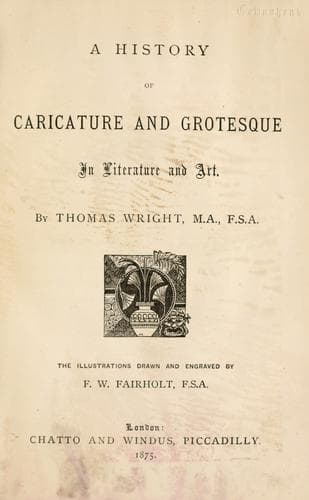
A History of Caricature and Grotesque in Literature and ArtWright, Thomas
History
A History of Caricature and Grotesque in Literature and Art
Wright, Thomas
Caricature -- History
[95] Pasquil and Pasquin became, during the latter part of the
sixteenth and the whole of the seventeenth centuries, a
well-known name in French and English literature. In English
popular literature he was turned into a jester, and a book was
published in 1604 under the title "Pasquil's Jests; with the
Merriments of Mother Bunch. Wittie, pleasant, and delightfull."
The pasquils formed a body of satire which struck indiscriminately at
everybody within its range, but satirists were now rising who took for
their subjects special cases of the general disorder. Rotten at the
heart, society presented an external glossiness, a mixture of pedantry
and affectation, which offered subjects enough for ridicule in whatever
point of view it was taken. The ecclesiastical body was in a state of
fermentation, out of which new feelings and new doctrines were about to
rise. The old learning and literature of the middle ages remained in
form after their spirit had passed away, and they were now contending
clumsily and unsuccessfully against new learning and literature of a
more refined and healthier character. Feudalism itself had fallen, or
it was struggling vainly against new political principles, yet the
aristocracy clung to feudal forms and feudal assumptions, with an
exaggeration which was meant for an appearance of strength. Among the
literary affectations of this false feudalism, was the fashion for
reading the long, dry, old romances of chivalry; while the churchmen
and schoolmen were corrupting the language in which mediæval learning
had been expressed, into a form the most barbarous, or introducing
words compounded from the later into the vernacular tongue. These
peculiarities were among the first to provoke literary satire. Italy,
where this class of satire originated, gave it its name also, though it
appears still to be a matter of doubt why it was called _macaronic_,
or in its Italian form _maccharonea_. Some have considered this name
to have been taken from the article of food called _macaroni_, to
which the Italians were, and still are, so much attached; while others
pretend that it was derived from an old Italian word _macarone_, which
meant a lubberly fellow. Be this, however, as it may, what is called
macaronic composition, which consists in giving a Latin form to words
taken from the vulgar tongue, and mixing them with words which are
purely Latin, was introduced in Italy at the close of the fifteenth
century.
Public-domain text, read in full here on John Shaqi.
Reviews
Reviews
No reviews yet
Be the first to share your thoughts on this work.
Elsewhere in the archive
Join the Discussion
Join the discussion
Sign in to leave a comment or review.
Sign InorCreate an account