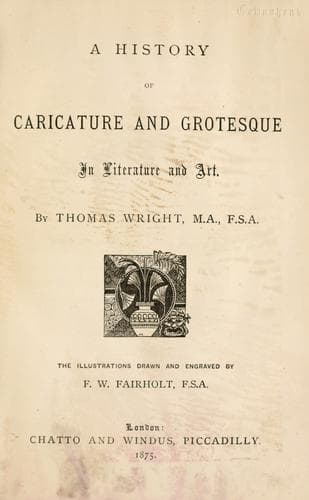
A History of Caricature and Grotesque in Literature and ArtWright, Thomas
History
A History of Caricature and Grotesque in Literature and Art
Wright, Thomas
Caricature -- History
_But when he returns from boasting Marseilles,
Very ill content, that she had repulsed him,
He found Antonio de Leyva very ill,
For whom terrible death is preparing a sorrowful bed.
Hectic fever tortures him in the ribs, and great pain;
Since things are going ill, he is weary of life.
Before his death he wished to speak an hour
To the emperor, and to give him counsel.
"You know, Cæsar, our affections are closely bound together,
For either body holds the two souls,
Alas! fly Provence the strong, fly the bitter shore,
Take care that your great glory prove not an injury to you."_
Thus Leyva goes on to persuade the emperor to abandon his enterprise,
and then dies. Arena exults over his death, and over the emperor's
grief for his loss, and then proceeds to describe the disastrous
retreat of the imperial army, and the glory of France in her king.
Antonius de Arena wrote with vigour and humour, but his verses are
tame in comparison with his model, Folengo. The taste for macaronic
verse never took strong root in France, and the few obscure writers
who attempted to shine in that kind of composition are now forgotten,
except by the laborious bibliographer. One named Jean Germain, wrote
a macaronic history of the invasion of Provence by the imperialists
in rivalry of Arenas. I will not follow the taste for this class of
burlesque composition into Spain or Germany, but merely add that it
was not adopted in England until the beginning of the seventeenth
century, when several authors employed it at about the same time.
The most perfect example of these early English macaronics is the
"Polemo-Middiana," _i.e._ battle of the dunghill, by the talented and
elegant-minded Drummond of Hawthornden. We may take a single example of
the English macaronic from this poem, which will not need an English
translation. One of the female characters in the dunghill war, calls,
among others, to her aid--
_Hunc qui dirtiferas tersit cum dishclouty dishras,
Hunc qui gruelias scivit bene lickere plettas,
Et saltpannifumos, et widebricatos fisheros,
Hellæosque etiam salteros duxit ab antris,
Coalheughos nigri girnantes more divelli;
Lifeguardamque sibi sævas vocat improba lassas,
Maggyam magis doctam milkare covœas,
Et doctam suepare flouras, et sternere beddas,
Quæque novit spinnare, et longas ducere threddas;
Nansyam, claves bene quæ keepaverat omnes,
Quæque lanam cardare solet greasy-fingria Betty._
Public-domain text, read in full here on John Shaqi.
Reviews
Reviews
No reviews yet
Be the first to share your thoughts on this work.
Elsewhere in the archive
Join the Discussion
Join the discussion
Sign in to leave a comment or review.
Sign InorCreate an account