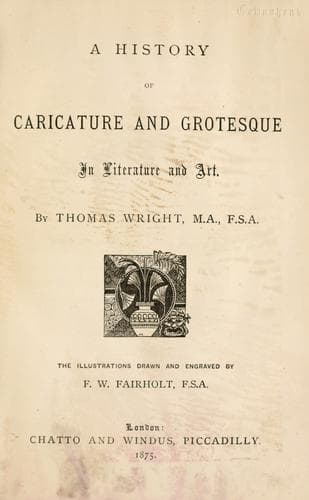
A History of Caricature and Grotesque in Literature and ArtWright, Thomas
History
A History of Caricature and Grotesque in Literature and Art
Wright, Thomas
Caricature -- History
Perhaps before this was written, the eccentric Thomas Coryat had
published in the volume of his Crudities, printed in 1611, a short
piece of verse, which is perfect in its macaronic style, but in which
Italian and other foreign words are introduced, as well as English. The
celebrated comedy of "Ignoramus," composed by George Ruggle in 1615,
may also be mentioned as containing many excellent examples of English
macaronics.
While Italy was giving birth to macaronic verse, the satire upon the
ignorance and bigotry of the clergy was taking another form in Germany,
which arose from some occurrences which it will be necessary to relate.
In the midst of the violent religious agitation at the beginning of
the sixteenth century in Germany, there lived a German Jew named
Pfeffercorn, who embraced Christianity, and to show his zeal for his
new faith, he obtained from the emperor an edict ordering the Talmud
and all the Jewish writings which were contrary to the Christian faith
to be burnt. There lived at the same time a scholar of distinction,
and of more liberal views than most of the scholastics of his time,
named John Reuchlin. He was a relative of Melancthon, and was secretary
to the palsgrave, who was tolerant like himself. The Jews, as might
be expected, were unwilling to give up their books to be burnt, and
Reuchlin wrote in their defence, under the assumed name of Capnion,
which is a Hebrew translation of his own name of Reuchlin, meaning
smoke, and urged that it was better to refute the books in question
than to burn them. The converted Pfeffercorn replied in a book entitled
"Speculum Manuale," in answer to which Reuchlin wrote his "Speculum
Oculare." The controversy had already provoked much bigoted ill-feeling
against Reuchlin. The learned doctors of the university of Cologne
espoused the cause of Pfeffercorn, and the principal of the university,
named in Latin Ortuinus Gratius, supported by the Sorbonne in Paris,
lent himself to be the violent organ of the intolerant party. Hard
pressed by his bigoted opponents, Reuchlin found good allies, but one
of the best of these was a brave baron named Ulric von Hutten, of an
old and noble family, born in 1488 in the castle of Staeckelberg,
in Franconia. He had studied in the schools at Fulda, Cologne, and
Frankfort on the Oder, and distinguished himself so much as a scholar,
that he obtained the degree of Master of Arts before the usual age.
But Ulric possessed an adventurous and chivalrous spirit, which led
him to embrace the profession of a soldier, and he served in the wars
in Italy, where he was distinguished by his bravery. He was at Rome
in 1516, and defended Reuchlin against the Dominicans. The same year
appeared the first edition of that marvellous book, the "Epistolæ
Obscurorum Virorum," one of the most remarkable satires that the world
has yet seen. It is believed that this book came entirely from the
pen of Ulric von Hutten; and the notion that Reuchlin himself, or
Public-domain text, read in full here on John Shaqi.
Reviews
Reviews
No reviews yet
Be the first to share your thoughts on this work.
Elsewhere in the archive
Join the Discussion
Join the discussion
Sign in to leave a comment or review.
Sign InorCreate an account