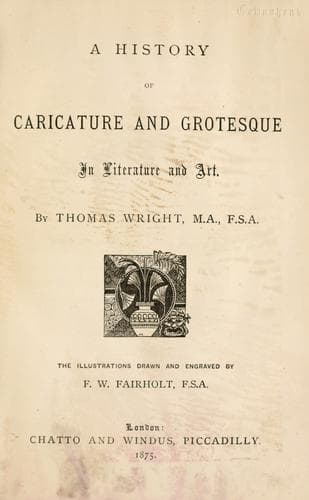
A History of Caricature and Grotesque in Literature and ArtWright, Thomas
History
A History of Caricature and Grotesque in Literature and Art
Wright, Thomas
Caricature -- History
any others of his friends, had a share in it appears to be without
foundation. Ulric was in the following year made poet-laureat.
Nevertheless, this book greatly incensed the monks against him, and he
was often threatened with assassination. Yet he boldly advocated the
cause and embraced the opinions of Luther, and was one of the staunch
supporters of Lutheranism. After a very turbulent life, Ulric von
Hutten died in the August of the year 1523.
The "Epistolæ Obscurorum Virorum," or letters of obscure men, are
supposed to be addressed to Ortuinus Gratius, mentioned above, by
various individuals, some his scholars, others his friends, but all
belonging to the bigoted party opposed to Reuchlin, and they were
designed to throw ridicule on the ignorance, bigotry, and immorality
of the clergy of the Romish church. The old scholastic learning
had become debased into a heavy and barbarous system of theology,
literary composition consisted in writing a no less barbarous Latin,
and even the few classical writers who were admitted into the schools,
were explained and commented upon in a strange half-theological
fashion. These old scholastics were bitterly opposed to the new
learning, which had taken root in Italy, and was spreading abroad,
and they spoke contemptuously of it as "secular." The letters of the
obscure individuals relate chiefly to the dispute between Reuchlin
and Pfeffercorn, to the rivalry between the old scholarship and the
new, and to the low licentious lives of the theologists; and they
are written in a style of Latin which is intended for a parody on
that of the latter, and which closely resembles that which we call
"dog-Latin."[97] They are full of wit and humour of the most exquisite
description, but they too often descend into details, treated in terms
which can only be excused by the coarse and licentious character of
the age. The literary and scientific questions discussed in these
letters are often very droll. The first in order of the correspondents
of Ortuinus Gratius, who boasts of the rather formidable name, Thomas
Langschneiderius, and addresses master Ortuinus as "poet, orator,
philosopher, and theologist, and more if he would," propounds to him a
difficult question:--
Public-domain text, read in full here on John Shaqi.
Reviews
Reviews
No reviews yet
Be the first to share your thoughts on this work.
Elsewhere in the archive
Join the Discussion
Join the discussion
Sign in to leave a comment or review.
Sign InorCreate an account