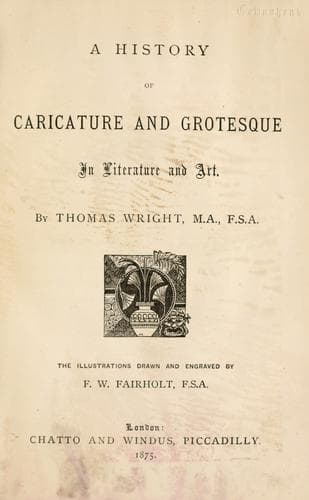
A History of Caricature and Grotesque in Literature and ArtWright, Thomas
History
A History of Caricature and Grotesque in Literature and Art
Wright, Thomas
Caricature -- History
led Rabelais to go on with it, and form the design of making these two
books part only of a more extensive romance. During his studies in
Paris, Pantagruel has made the acquaintance of a singular individual
named Panurge, who becomes his attached friend and constant companion,
holding somewhat the position of brother Jean in the first book, but
far more crafty and versatile. The whole subject of the third book
arises out of Pantagreul's desire to marry, and its various amusing
episodes describe the different expedients which, at the suggestion of
Panurge, he adopts to arrive at a solution of the question whether his
marriage would be fortunate or not.
In publishing his fourth book, Rabelais complains that his writings
had raised him enemies, and that he was accused of having at least
written heresy. In fact, he had bitterly provoked both the monks and
the university and parliament; and, as the increasing reaction of
Romanism in France gave more power of persecution to the two latter,
he was not writing without some degree of danger, yet the satire of
each successive book became bolder and more direct. The fifth, which
was left unfinished at his death, and which was published posthumously,
was the most severe of them all. The character of Gargantua, indeed,
was almost forgotten in that of Pantagruel, and Pantagruelism became
an accepted name for the sort of gay, reckless satire of which he was
looked upon as the model. He described it himself as a _certaine gaieté
d'esprit confite en mépris des choses fortuites_, in fact, neither
Romanism nor Protestantism, but simply a jovial kind of Epicurianism.
All the gay wits of the time aspired to be Pantagruelists, and the
remainder of the sixteenth century abounded in wretched imitations of
the style of Rabelais, which are now consigned as mere rarities to the
shelves of the bibliophilist.
Among the dangers which began to threaten them in France in the earlier
part of the sixteenth century, liberal opinions found an asylum at the
court of a princess who was equally distinguished by her beauty, by her
talents and noble sentiments, and by her accomplishments. Marguerite
d'Angoulême, queen of Navarre, was the only sister of François I., who
was her junior by two years, and was affectionately attached to her.
She was born on the 11th of April, 1492. She had married, first, that
unfortunate duke d'Alençon, whose misconduct at Pavia was the cause of
the disastrous defeat of the French, and the captivity of their king.
The duke died, it was said of grief at his misfortune, in 1525; and
two years afterwards, on the 24th of January, 1527, she married Henri
d'Albret, king of Navarre. Their daughter, Jeanne d'Albret, carried
this petty royalty to the house of Bourbon, and was the mother of Henri
IV.
Public-domain text, read in full here on John Shaqi.
Reviews
Reviews
No reviews yet
Be the first to share your thoughts on this work.
Elsewhere in the archive
Join the Discussion
Join the discussion
Sign in to leave a comment or review.
Sign InorCreate an account