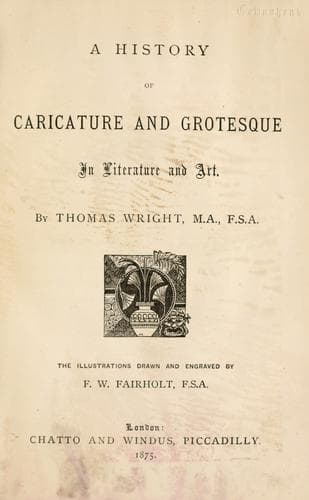
A History of Caricature and Grotesque in Literature and ArtWright, Thomas
History
A History of Caricature and Grotesque in Literature and Art
Wright, Thomas
Caricature -- History
The school of scepticism to which Des
Periers belonged had now fallen into equal discredit with Catholics and
Protestants, and the latter looked upon Marguerite herself, who had
latterly conformed outwardly with Romanism, as an apostate from their
cause. Henri Estienne, in his "Apologie pour Herodote," speaks of the
"Cymbalum Mundi" as an infamous book.
[98] A cheap and convenient edition of the "Cymbalum Mundi," edited
by the Bibliophile Jacob (Paul Lacroix), was published in Paris
in 1841. I may here state that similar editions of the principal
French satirists of the sixteenth century have been printed
during the last twenty-five years.
Bonaventure des Periers left behind him another work more amusing to us
at the present day, and more characteristic of the literary tastes of
the court of Marguerite of Navarre. This is a collection of facetious
stories, which was published several years after the death of its
author, under the title of "Les Contes, ou Les Nouvelles Récréations et
Joyeux Devis de Bonaventure des Periers." They have some resemblance
in style to the stories of the Heptameron, but are shorter, and rather
more facetious, and are characterised by their bitter spirit of satire
against the monks and popish clergy. Some of these stories remind us,
in their peculiar character and tone, of the "Epistolæ Obscurorum
Virorum," as, for an example, the following, which is given as an
anecdote of the curé de Brou:--
"This curé had a way of his own to chant the different offices
of the church, and above all he disliked the way of saying the
Passion in the manner it was ordinarily said in churches, and he
chanted it quite differently. For when our Lord said anything to
the Jews, or to Pilate, he made him talk high and loud, so that
everybody could hear him, and when it was the Jews or somebody
else who spoke, he spoke so low that he could hardly be heard
at all. It happened that a lady of rank and importance, on her
way to Châteaudun, to keep there the festival of Easter, passed
through Brou on Good Friday, about ten o'clock in the morning,
and, wishing to hear service, she went to the church where the
curé was officiating. When it came to the Passion, he said it
in his own manner, and made the whole church ring again when
he said _Quem quæritis_? But when it came to the reply, _Jesum
Nazarenum_, he spoke as low as he possibly could. And in this
manner he continued the Passion. The lady, who was very devout,
and, for a woman, well informed in the holy scriptures, and
attentive to the ecclesiastical ceremonies, felt scandalised
at this mode of chanting, and wished she had never entered the
church. She had a mind to speak to the curé, and tell him what
she thought of it; and for this purpose sent for him to come to
her after the service. When he came, she said to him, 'Monsieur
Public-domain text, read in full here on John Shaqi.
Reviews
Reviews
No reviews yet
Be the first to share your thoughts on this work.
Elsewhere in the archive
Join the Discussion
Join the discussion
Sign in to leave a comment or review.
Sign InorCreate an account