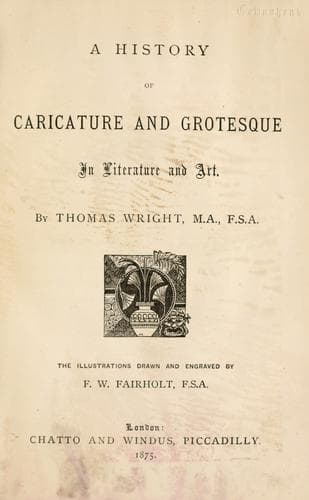
A History of Caricature and Grotesque in Literature and ArtWright, Thomas
History
A History of Caricature and Grotesque in Literature and Art
Wright, Thomas
Caricature -- History
Before Marguerite's death, her literary circle had been broken up by
the hatred of religious persecutors. Already, in 1536, the imprudent
boldness of Marot had rendered it impossible to protect him any
longer, and he had been obliged to retire to a place of concealment,
from whence he sometimes paid a stealthy visit to her court. His
place of _valet-de-chambre_ was given to a man of talents, even more
remarkable, and who shared equally the personal esteem of the queen of
Navarre, Bonaventure des Periers. Marot's successor paid a graceful
compliment to him in a short poem entitled "L'Apologie de Marot
absent," published in 1537. The earlier part of the year following
witnessed the publication of the most remarkable work of Bonaventure
des Periers, the "Cymbalum Mundi," concerning the real character
of which writers are still divided in opinion. In it Des Periers
introduced a new form of satire, imitated from the dialogues of Lucian.
The book consists of four dialogues, written in language which forms a
model of French composition, the personages introduced in them intended
evidently to represent living characters, whose names are concealed
in anagrams and other devices, among whom was Clement Marot. It was
the boldest declaration of scepticism which had yet issued from the
Epicurean school represented by Rabelais. The author sneers at the
Romish church as an imposture, ridicules the Protestants as seekers
after the philosopher's stone, and shows disrespect to Christianity
itself. Such a book could hardly be published in Paris with impunity,
yet it was printed there, secretly, it is said, by a well-known
bookseller, Jean Morin, in the Rue St. Jacques, and therefore in the
immediate vicinity of the persecuting Sorbonne. Private information
had been given of the character of this work, possibly by the printer
himself or by one of his men, and on the 6th of March, 1538, when it
was on the eve of publication, the whole impression was seized at the
printer's, and Morin himself was arrested and thrown into prison. He
was treated rigorously, and is understood to have escaped only by
disavowing all knowledge of the character of the book, and giving up
the name of the author. The first edition of the "Cymbalum Mundi" was
burnt, and Bonaventure des Periers, alarmed by the personal dangers
in which he was thus involved, retired from the court of the queen of
Navarre, and took refuge in the city of Lyons, where liberal opinions
at that time found a greater degree of tolerance than elsewhere. There
he printed a second edition of the "Cymbalum Mundi," which also was
burnt, and copies of either edition are now excessively rare.[98]
Bonaventure des Periers felt so much the weight of the persecution in
which he had now involved himself, that, in the year 1539, as far as
can be ascertained, he put an end to his own existence. This event cast
a gloom over the court of the queen of Navarre, from which it seems
never to have entirely recovered.
Public-domain text, read in full here on John Shaqi.
Reviews
Reviews
No reviews yet
Be the first to share your thoughts on this work.
Elsewhere in the archive
Join the Discussion
Join the discussion
Sign in to leave a comment or review.
Sign InorCreate an account